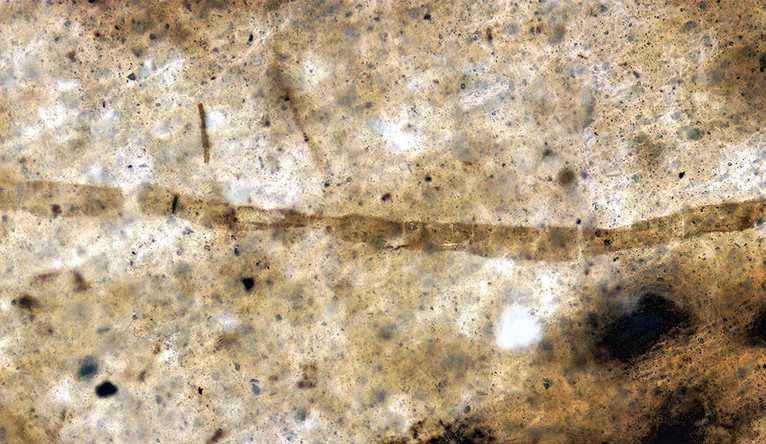
Fossilized proterocladus - an ancient, seaweed-like organism - is visible in this clay sample from Svalbard, Norway.
Fossilized proterocladus - an ancient, seaweed-like organism - is visible in this clay sample from Svalbard, Norway. Clay is king for creating ancient fossils. In a new study, researchers confirmed that kaolinite, a mineral found in certain fine-grained rocks around the world, is a key ingredient for preserving some of the earliest forms of complex life. The researchers also said the importance of kaolinite in the fossilization process has led to a bias in the early fossil record toward organisms that lived in places where kaolinite forms. " This insight may provide a blueprint for paleoenvironments that are conducive to ancient fossils on Earth and possibly on other planets, like Mars," said senior author Derek Briggs , the G. Evelyn Hutchinson Professor of Geology & Geophysics in the Yale Faculty of Arts and Sciences. Briggs said he and his colleagues wanted to understand the fossilization process for complex life forms that lived before the evolution of diverse skeletons during the so-called Cambrian era, which began about 541 million years ago. The researchers investigated microscopic, soft-bodied pre-Cambrian organisms as old as around 800 million years from sites in Russia, the Canadian Arctic, and the Norwegian archipelago Svalbard.
TO READ THIS ARTICLE, CREATE YOUR ACCOUNT
And extend your reading, free of charge and with no commitment.