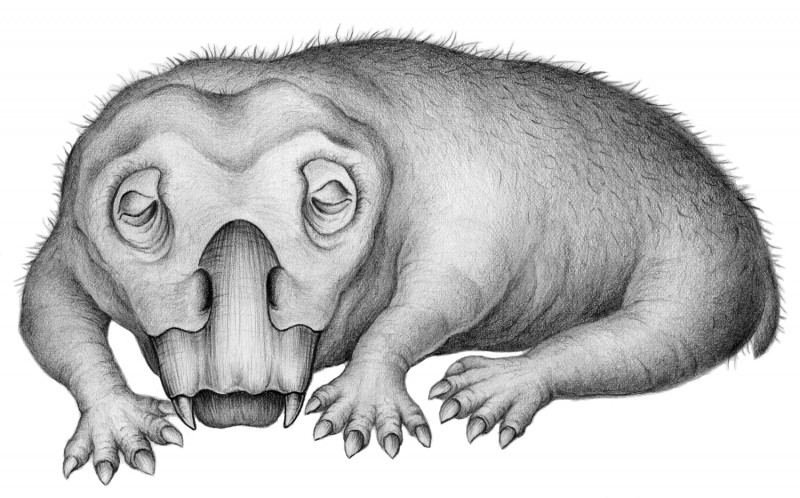
Life restoration of Lystrosaurus in a state of torpor. Crystal Shin
Life restoration of Lystrosaurus in a state of torpor. Crystal Shin - Prepared by Megan Whitney with Harvard University and Christian Sidor with the University of Washington and the Burke Museum of Natural History and Culture. University of Washington press release here. Reference: " Evidence of torpor in the tusks of Lystrosaurus from the Early Triassic of Antarctica " by Whitney MR and Sidor CA. Communications Biology. DOI: 10.1038/s42003-020-01207-6 Major findings We provide evidence for a hibernation-like condition in Lystrosaurus , a mammal relative that lived in the Antarctic portion of Pangea about 250 million years ago. This discovery was enabled by high-resolution of incremental growth marks preserved in the tusks of Lystrosaurus . Frequently Asked Questions What is Lystrosaurus ? Lystrosaurus is a type of dicynodont , a major group of primarily herbivorous vertebrates that were common during the Permian and Triassic periods. Dicynodonts are characterized by their turtle-like beaks and ever-growing tusks, which are present in most species. They are distantly related to modern mammals. Lystrosaurus is known from rocks from about 253-248 million years ago and ranged from about the size of a corgi to slightly smaller than a cow. Fossils of Lystrosaurus are known from China, Russia, India, South Africa and Antarctica and this geographic distribution was one of the early pieces of evidence used in support of a large supercontinent called Pangea. Fossils of Lystrosaurus have been found in burrow structures in South Africa and similar burrow trace fossils have been recovered from Antarctica, but not with Lystrosaurus inside them. What is torpor?
TO READ THIS ARTICLE, CREATE YOUR ACCOUNT
And extend your reading, free of charge and with no commitment.