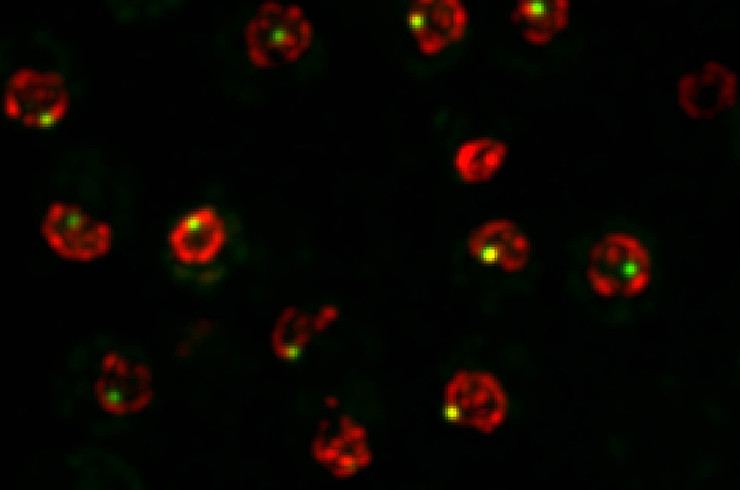
Representative image of a GFP-tagged chromosomal locus near an inducible double strand break in S.cerevisiae. The nuclear periphery is visualized using a nuclear pore marker.
Representative image of a GFP-tagged chromosomal locus near an inducible double strand break in S.cerevisiae. The nuclear periphery is visualized using a nuclear pore marker. DNA damage can occur anywhere in the genome, but most DNA is wrapped around nucleosomes making it inaccessible to the repair machinery. Researchers from the Gasser group now show that DNA damage induces histone depletion, which increases the accessibility and flexibility of the DNA fiber and enhances the rate of homology search during repair by homologous recombination. For several years, the Gasser group has been studying how chromatin structure changes in response to DNA damage in order to understand if and how those changes increase the rate of repair. In an earlier study, Michael Hauer, a former PhD candidate in the Gasser lab, showed that there is both a local and a genome-wide response of chromatin to acute DNA damage, with about 30% of the histones being modified, removed and degraded genome-wide, and not only at sites of damage. This drives chromatin to be more mobile in the nucleus.
TO READ THIS ARTICLE, CREATE YOUR ACCOUNT
And extend your reading, free of charge and with no commitment.