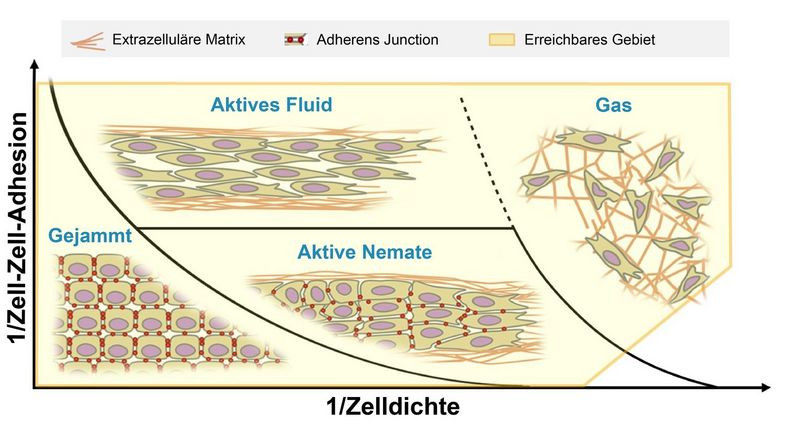
Schematic representation of different types of movement of tumour tissue in the extracellular matrix. Image: Peter Friedl, Stefano Zappen, Andreas Deutsch, Josef A. Käs, Jürgen Lippoldt
Schematic representation of different types of movement of tumour tissue in the extracellular matrix. Image: Peter Friedl, Stefano Zappen, Andreas Deutsch, Josef A. Käs, Jürgen Lippoldt In cooperation with colleagues from Germany, Italy and the Netherlands, researchers at Leipzig University have investigated the structure of tumour tissue and the behaviour of tumour cells in detail, gaining important insights that could improve cancer diagnosis and therapy in the future. They found out that during tumour development the way cells move can change from coordinated and collective to individual and chaotic behaviour. They have just published their research findings in the journal "Nature Cell Biology". The paper was supervised by tumour biologist Professor Peter Friedl of Radboud University in Nijmegen, the Netherlands, in cooperation with the research groups headed by Professor Josef A. Käs (Leipzig University), Professor Andreas Deutsch (TU Dresden) and Professor Stefano Zapperi (University of Milan). The scientists studied biological changes that cells usually undergo as cancer develops. The most typical of these is the degradation of the epithelial adhesion molecule E-cadherin.
TO READ THIS ARTICLE, CREATE YOUR ACCOUNT
And extend your reading, free of charge and with no commitment.