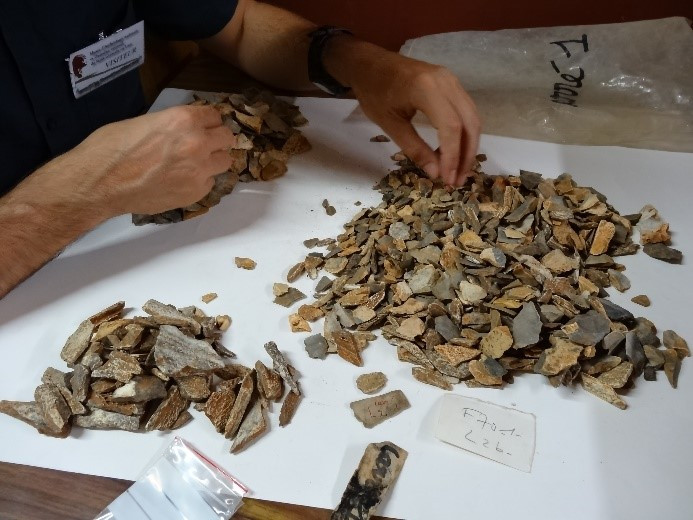
 Examining material from the 1970s excavations at the Musée d’archéologie nationale, France. Thousands of bone remains were sorted and 47 new fossil remains belonging to the Neandertal child ’La Ferrassie 8’ were identified.
Examining material from the 1970s excavations at the Musée d'archéologie nationale, France. Thousands of bone remains were sorted and 47 new fossil remains belonging to the Neandertal child 'La Ferrassie 8' were identified. Antoine Balzeau - CNRS/MNHN - Was burial of the dead practiced by Neandertals or is it an innovation specific to our species? There are indications in favour of the first hypothesis but some scientists remain sceptical. For the first time in Europe, however, a multi-disciplinary team led by researchers at the CNRS and the Muséum national d'histoire naturelle (France) and the University of the Basque Country (Spain) 1 has demonstrated, using a variety of criteria, that a Neandertal child was buried, probably around 41,000 years ago, at the Ferrassie site (Dordogne). Their study is published in the journal Scientific Reports on 9th December 2020. The other contributors to this study work at the Institut de recherche sur les archéomatériaux - Centre de recherche en physique appliquée à l'archéologie (CNRS/Université Bordeaux Montaigne), the Géosciences Rennes laboratory (CNRS/Université Rennes 1), De la Préhistoire à l'actuel : culture, environnement et anthropologie laboratory (CNRS/Université de Bordeaux/Ministère de la Culture), the Musée d'archéologie nationale and the Musée national de Préhistoire des Eyzies-de-Tayac in France; at the Max Planck Institute for Evolutionary Anthropology in Germany; at the University of Bologna in Italy; at the University of Copenhagen in Denmark.
TO READ THIS ARTICLE, CREATE YOUR ACCOUNT
And extend your reading, free of charge and with no commitment.
Your Benefits
- Access to all content
- Receive newsmails for news and jobs
- Post ads