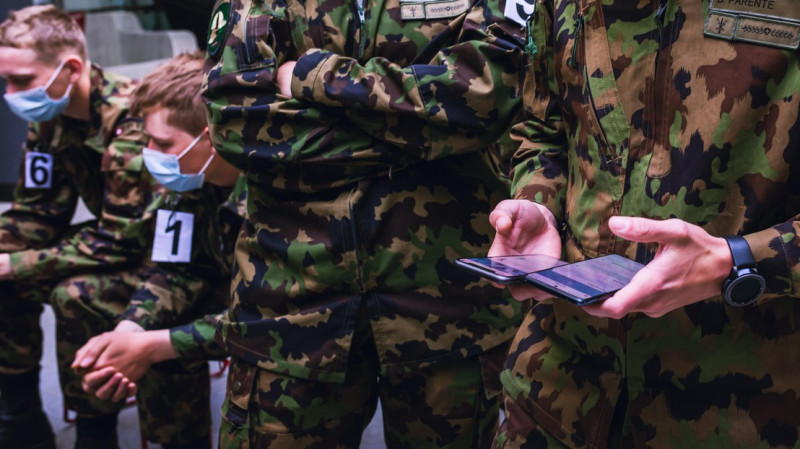
 Testing the DP3T app at
Testing the DP3T app at EPFL © 2020 Jamani Caillet Over the past two weeks, EPFL computer scientists have been testing and refining the smartphone-based system developed by the international Decentralized Privacy-Preserving Proximity Tracing project (DP3T), with the help of the Swiss Army. Their goal: to optimize the app's ability to alert users after they've been in contact with someone contagious with COVID-19, while building trust around the open system. DP3T is an approach to decentralized, privacy-preserving contact tracing that aims to provide a digital means for humans to stop the spread of the novel coronavirus. The project was initially launched by researchers from EPFL and ETH Zurich, and is now being developed in collaboration with a number of other leading European institutions , as well as software developers Ubique and PocketCampus. Mathias Payer, head of the HexHive lab in EPFL's School of Computer and Communication Sciences ( IC ), explains that recent tests carried out on the EPFL campus were designed to compare the DP3T system's proximity measurements with data on Swiss Army soldiers' physical positions. The soldiers were asked to mimic daily activities like shopping or sitting on a train, while their positions were captured and analyzed using specialized cameras from EPFL'S Computer Vision Laboratory ( CVLab ), led by Pascal Fua. On April 30
th, just a week after the EPFL tests, Payer led a 24-hour field test at a military facility with about 100 soldiers.
TO READ THIS ARTICLE, CREATE YOUR ACCOUNT
And extend your reading, free of charge and with no commitment.
Your Benefits
- Access to all content
- Receive newsmails for news and jobs
- Post ads