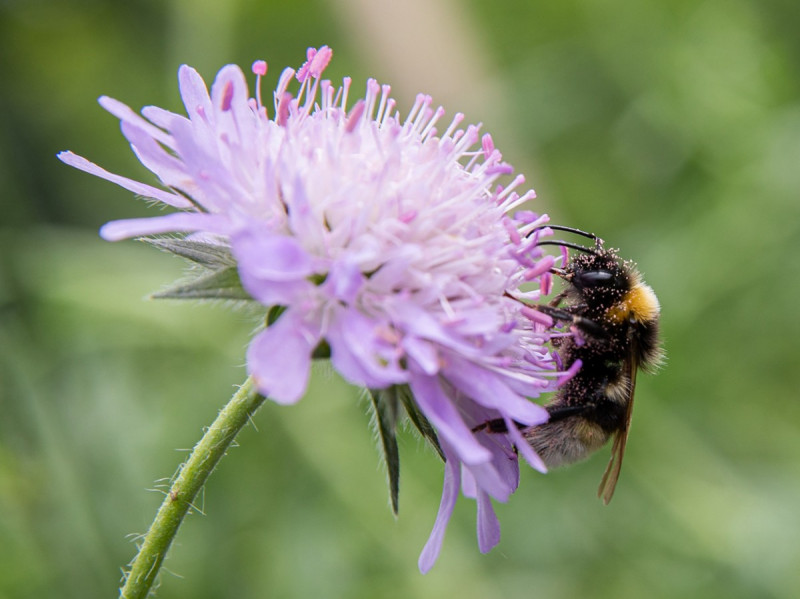
 A bumblebee covered with pollen grains samples a field scabious.© WWU - Peter Leßmann
A bumblebee covered with pollen grains samples a field scabious. WWU - Peter Leßmann An abandoned space in the middle of Münster: in the historic medicinal plant garden, which hasn't been in use since 2016, nature can pretty much do what it likes. At least, it almost can - anyone who fights their way through an overgrown meadow between Einsteinstraße and Schlossgräfte will come across a clearing, about 50 square metres in size, on which meadow plants are arranged in rows of pots standing on black groundsheets. These are test objects belonging to plant ecologist Dr. Anna Lampei-Bucharova, who chose this place off the beaten track for her research. Birds twitter and, if you listen carefully enough, you can also clearly hear the buzzing of bumblebees going about their busy work among the yellow and lilac blooms on the plants. It is idyllic, but the experiment also has a serious aim - to repair something that has been destroyed. With her research, Anna Lampei-Bucharova wants to help to restore ecosystems humans have destroyed, for example as a result of construction work or agriculture. And there are many of them. "In the Münsterland there is practically no nature left, apart from small areas here and there," says Anna Lampei-Bucharova, who is based at the Institute of Landscape Ecology at Münster University. In her projects, she examines which plants - depending on the location - can best be used for certain restoration measures. In doing so, she has a long-term aim. Which species of plants are best suited in view of climate change and the few degrees Celsius of global warming expected in the coming years?
TO READ THIS ARTICLE, CREATE YOUR ACCOUNT
And extend your reading, free of charge and with no commitment.
Your Benefits
- Access to all content
- Receive newsmails for news and jobs
- Post ads