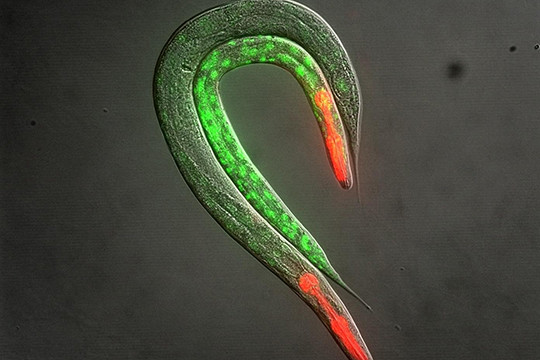
Two developing worms both expressing a red fluorescent marker that lights up the digestive organ and a green fluorescent marker that is expressed in all cells of the body, only when the repression of Polycomb-marked genes is compromised. Here the derepression of the GFP reporter does not entail loss of a histone modifier, but loss of mRNA degradation by LSM2-8 and XRN-2.
Two developing worms both expressing a red fluorescent marker that lights up the digestive organ and a green fluorescent marker that is expressed in all cells of the body, only when the repression of Polycomb-marked genes is compromised. Here the derepression of the GFP reporter does not entail loss of a histone modifier, but loss of mRNA degradation by LSM2-8 and XRN-2. The Gasser group discovered that silencing of heterochromatic regions - and more specifically of hundreds of Polycomb-target genes enriched for H3K27me3 - can occur through selective RNA degradation, and not only through transcriptional repression. The study links the epigenetics state of a gene with the fate of its RNA transcript. It is the first time that this is shown in higher eukaryotes. Heterochromatin, the dark-staining transcriptionally silent compartment of the genome, correlates with repressed gene expression. In fission yeast and plants, RNA processing and degradation contribute to heterochromatin silencing, alongside conserved pathways of transcriptional repression.
TO READ THIS ARTICLE, CREATE YOUR ACCOUNT
And extend your reading, free of charge and with no commitment.