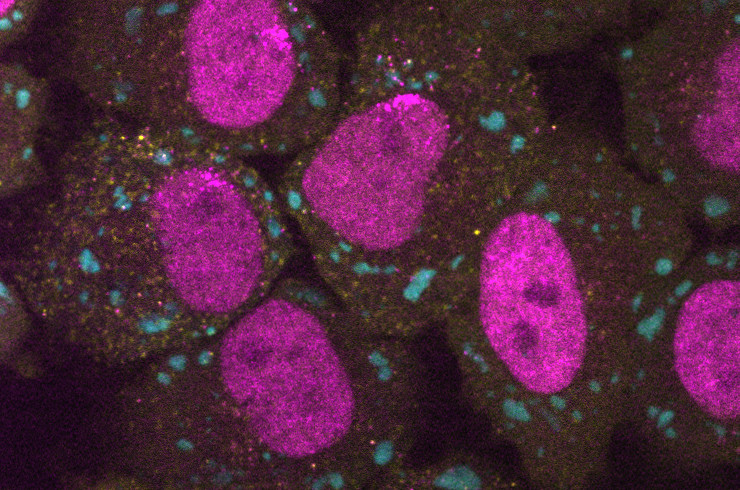
ATF4-SunTag transcripts (magenta) can undergo translation (yellow) when localized to stress granules (blue) in HeLa cells.
ATF4-SunTag transcripts ( magenta ) can undergo translation ( yellow ) when localized to stress granules ( blue ) in HeLa cells. Just like people, cells get stressed too. A sudden drop in oxygen, overheating, or toxins can trigger a cascade of molecular changes that lead cells to stop growing, produce stress-protective factors, and form stress granules - proteins and RNA molecules huddled together into membrane-less organelles. Although the function of stress granules remains largely unknown, it is assumed that they contain only RNAs that are not translated into proteins. Now, a study upends this longstanding idea, showing that messenger RNAs (mRNAs) within stress granules can indeed make proteins. mRNAs are single stranded molecules of RNA, which are transcribed from DNA in the nucleus - for eukaryotes - and are then transported to the cytosol where they are translated into proteins. During the cellular stress response, many mRNAs cluster inside stress granules - an observation that led scientists to think that these mRNAs stopped getting translated when the cell is threatened.
TO READ THIS ARTICLE, CREATE YOUR ACCOUNT
And extend your reading, free of charge and with no commitment.