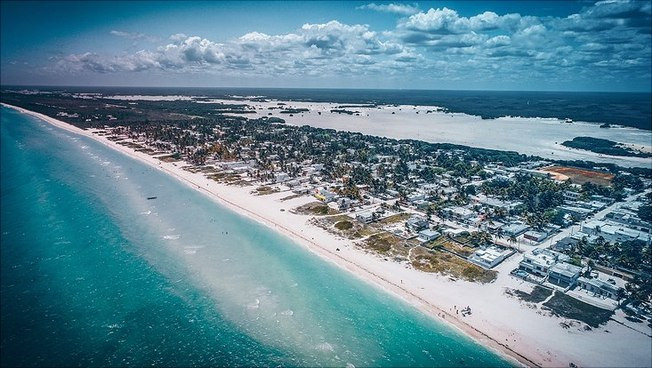
Photo: J. Zapata / unsplash Half of the world’s population lives near the coast. Sea-level rise can become a risk.
Photo: J. Zapata / unsplash Half of the world's population lives near the coast. Sea-level rise can become a risk. One major consequence of global warming is the rising sea level. A study conducted at Universität Hamburg's Cluster of Excellence for climate research CLICCS now shows: if we assume that sea-level rise is the most critical effect of climate change, then it is not only more sensible, but also less expensive, to set a maximum limit for sea-level rise that corresponds to the two-degree target, rather than a temperature-based target. To date, climate protection targets have consistently been oriented on the mean global temperature, just as defined in the Paris Agreement: the goal is to limit mean warming to 2 degrees, or ideally, to 1.5 degrees Celsius. A joint research team from the Max Planck Institute for Meteorology and Universität Hamburg has now converted these temperature-based targets into sea-level-based equivalents. The team's goal is to spark a new discourse concerning whether, and if so, how, climate targets should be adapted once we know more about the impacts of climate change.
TO READ THIS ARTICLE, CREATE YOUR ACCOUNT
And extend your reading, free of charge and with no commitment.