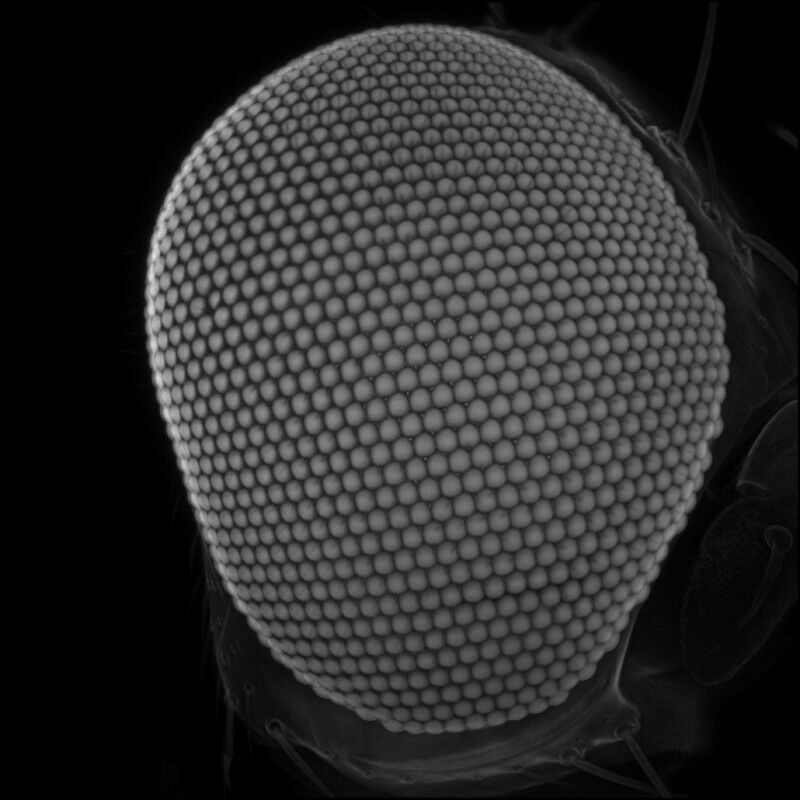
The compound eyes of insects often consist of hundreds of individual eyes. Photo: Georg Bullinger
The compound eyes of insects often consist of hundreds of individual eyes. Photo: Georg Bullinger Research team led by Göttingen University investigates molecular basis of eye size variation in insects The fascinating compound eyes of insects consist of hundreds of individual eyes known as -facets-. In the course of evolution, an enormous variety of eye sizes and shapes has emerged, often representing adaptations to different environmental conditions. Scientists, led by an Emmy Noether research group at the University of Göttingen, together with scientists from the Andalusian Centre for Developmental Biology (CABD) in Seville, have now shown that these differences can be caused by very different changes in the genome of fruit flies. The study was published in the journal Molecular Biology and Evolution. Anyone who has seen hoverflies manoeuvring through the air and, quick as a flash, changing direction, has probably witnessed a mating attempt in which the male, with breath-taking accuracy, pursues a fast-moving female. To carry out this specialised visual task, the huge compound eyes of hoverflies consist of up to 6,000 individual facets.
TO READ THIS ARTICLE, CREATE YOUR ACCOUNT
And extend your reading, free of charge and with no commitment.