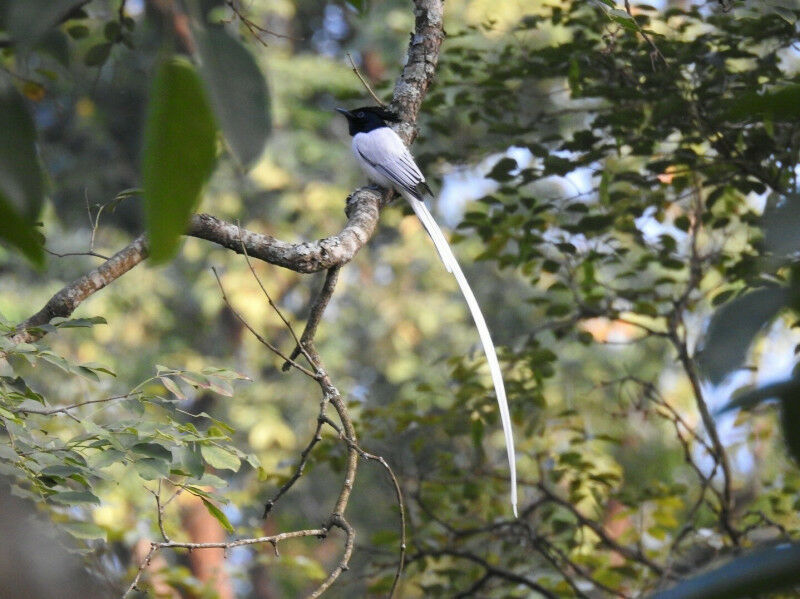
Many birds, like this Indian Paradise Flycatcher (Terpsiphone paradisi) which eats insects, would not thrive in an urban environment. Photo: Gabriel Marcacci
Many birds, like this Indian Paradise Flycatcher (Terpsiphone paradisi) which eats insects, would not thrive in an urban environment. Photo: Gabriel Marcacci Research team led by Göttingen University investigates farmland birds in an Indian megacity Urbanization is one of the most drastic forms of land-use change, and its negative consequences on biodiversity have been studied extensively in temperate countries such as Germany. However, less research has been conducted in tropical regions from the Global South, where most of the ongoing and future urbanization hotspots are located, and little is known about its effects on agricultural biodiversity and associated ecosystems. A research team from the University of Göttingen and the University of Hohenheim, in collaboration with the University of Agricultural Sciences of Bangalore in India, investigated the effects of urbanization on farmland bird communities in and around Bangalore, a city of over 10 million inhabitants in South India. They found that urbanization homogenizes farmland bird communities, filtering out species with certain functional traits, such as insect-eating birds, which are important for pest control. The results were published in Global Change Biology. A local ornithological expert conducted regular bird surveys over one year and recorded 126 bird species.
TO READ THIS ARTICLE, CREATE YOUR ACCOUNT
And extend your reading, free of charge and with no commitment.