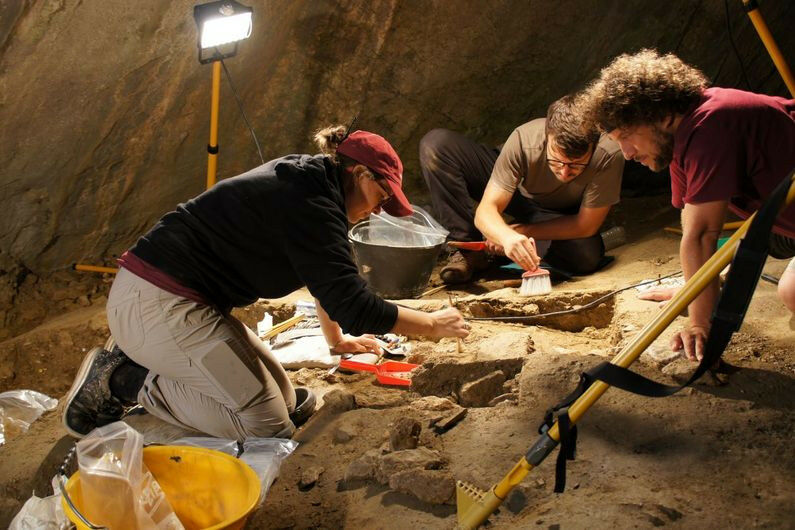
UdeM archaeologist Julien Riel-Salvatore (r) and his doctoral candidate Geneviève Pothier Bouchard (l) excavating the burial site of baby Neve in the Arma Veirana cave in Liguria, Italy, in 2018; in the background is PhD candidate Simon Paquin. Credit: David Strait
UdeM archaeologist Julien Riel-Salvatore (r) and his doctoral candidate Geneviève Pothier Bouchard (l) excavating the burial site of baby Neve in the Arma Veirana cave in Liguria, Italy, in 2018; in the background is PhD candidate Simon Paquin. Credit: David Strait - When baby 'Neve' died 10,000 years ago, she was accorded a proper burial recognizing her as a full person, archeologists on a dig in Italy find. The baby girl was born roughly 10,000 years ago, after the end of the last Ice Age in what is now Liguria, northwestern Italy, but didn't survive more than two months. After she died, she was given a proper burial honouring her as a fully fledged person in her society - a remarkable testament to female equality in Mesolithic times. That's the conclusion drawn today by a team of archeologists including Université de Montréal's Julien Riel-Salvatore and Claudine Gravel-Miguel , UdeM doctoral candidate Geneviève Pothier Bouchard and scientists in the U.S. Italy and Germany, in a study led by researchers at the University of Colorado and the University of Genoa, and published in Nature Scientific Reports.
TO READ THIS ARTICLE, CREATE YOUR ACCOUNT
And extend your reading, free of charge and with no commitment.