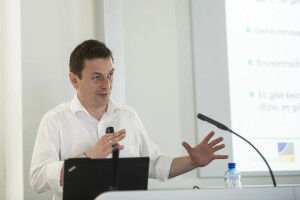
Claire Stevenson, assistant professor of Psychological Methods
Claire Stevenson, assistant professor of Psychological Methods - Research on AI in the spotlight AI can often process more information than humans, but that doesn't extend to our ability to reason by analogy. This form of reasoning is considered the greatest strength of human intelligence. While humans can think up solutions to new problems based on relationships with familiar situations, this ability is virtually absent in AI. Claire Stevenson is researching intelligence and analogical reasoning in both AI and children and how the two might learn from each other. The key question behind the research by Claire Stevenson, assistant professor of Psychological Methods, is: 'How do humans manage to become so smart'' She analyses the development of intelligence and the creative process, specifically in children and AI. Stevenson's research combines her knowledge of developmental psychology with her background in mathematical modelling and computer science. 'I'm basically trying to test human intelligence in AI, and test AI intelligence in children.' - Analogical reasoning in children . Claire Stevenson started her academic career in the field of developmental psychology, where she researched children's learning potential: 'so not what they already know, but what they are capable of.' She examined the development of analogical reasoning in children, i.e. their ability to find solutions to new problems based on relationships with familiar ones. 'For example, children were asked to complete the sequence: thirst is to drinking as bleeding is to bandage, wound, cutting, water or food?
TO READ THIS ARTICLE, CREATE YOUR ACCOUNT
And extend your reading, free of charge and with no commitment.