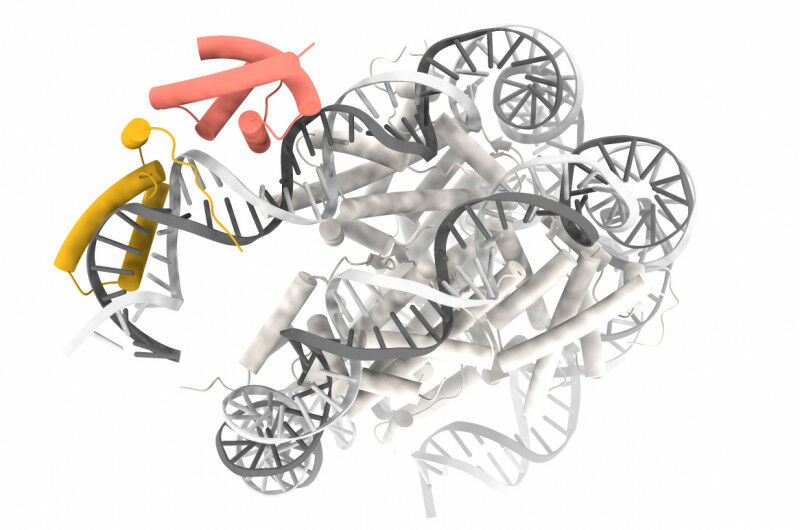
Visualization obtained with cryo-EM of two transcription factors (yellow and red) bound to DNA wrapped within a nucleosome.
Visualization obtained with cryo-EM of two transcription factors (yellow and red) bound to DNA wrapped within a nucleosome. How can proteins bind DNA in the cell nucleus, where it is present in form of chromatin, tightly wrapped around histones and therefore mostly inaccessible? Recently, several studies began to uncover the various strategies used by DNA-binding proteins to solve this problem. In a Cell "Leading Edge review", Alicia Michael and Nico Thomä look at these findings and highlight general principles that aim to help predict how a protein recognizes a specific stretch of DNA, even when "hidden" in chromatin. Nearly 35 years ago, scientists determined for the first time the structure of a protein bound to DNA, contributing to a good understanding of how proteins bind a specific stretch of DNA. However, most studies since then have been conducted on isolated DNA in a test tube, whereas DNA in the cell is wrapped around histone proteins that form nucleosomes, the elementary building blocks of chromatin. When a DNA sequence is close to histones, it becomes inaccessible to other proteins such as transcription factors (TFs) or repair enzymes. For this reason, DNA-binding proteins need different strategies to interact with DNA when it is packaged in the chromatin fiber.
TO READ THIS ARTICLE, CREATE YOUR ACCOUNT
And extend your reading, free of charge and with no commitment.