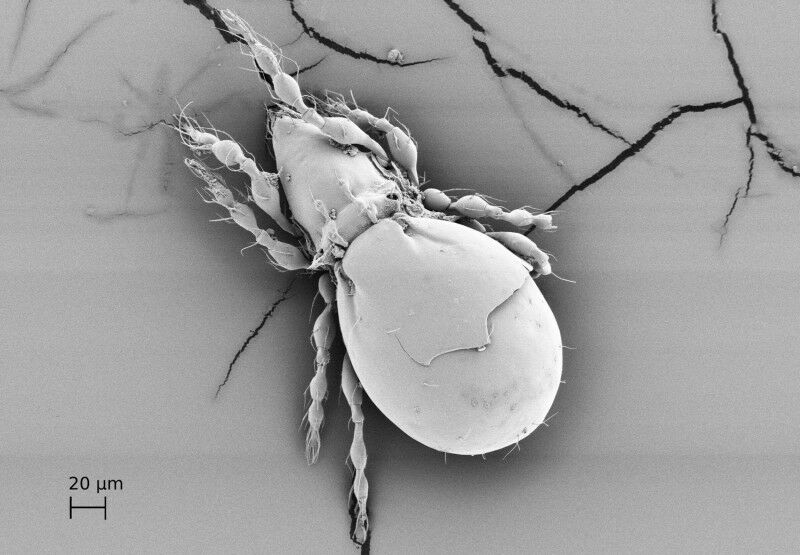
The ’ancient asexuel scandal’, the soil mite Oppiella nova Photo: M. Maraun and K. Wehner
The 'ancient asexuel scandal', the soil mite Oppiella nova Photo: M. Maraun and K. Wehner - International researchers including the University of Göttingen demonstrate for the first time that animals can survive very long periods of time without sex It was thought that the survival of animal species over a geologically long period of time without sexual reproduction would be very unlikely, if not impossible. However, an international research team of zoologists and evolutionary biologists at the Universities of Cologne and of Göttingen, as well as Universities in Lausanne (Switzerland) and Montpelier (France), has now demonstrated for the first time that animals can reproduce successfully without sex in the long term, perhaps for millions of years. They studied the Meselson effect - a characteristic trace in the genome of an organism suggesting reproduction has been asexual - in the ancient asexual beetle mite species Oppiella nova . The results were published in PNAS . So far, scientists have observed the great evolutionary advantages of sexual reproduction from the genetic diversity produced in offspring from the encounters of two different genomes that a pair of parents can supply. In organisms with two sets of chromosomes, i.e. two copies of the genome in each of their cells, such as humans and also beetle mite species that reproduce sexually, sex ensures a constant 'mixing' of the two copies. That way, genetic diversity between different individuals is ensured, but the two copies of the genome within the same individual remain on average very similar.
TO READ THIS ARTICLE, CREATE YOUR ACCOUNT
And extend your reading, free of charge and with no commitment.