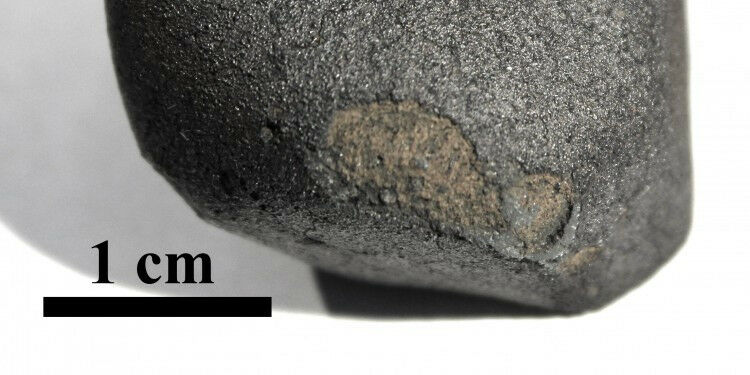
 Flensburg meteorite with black fusion crust: Parts of the fusion crust were lost during the flight through the atmosphere. The small fragment, weighing 24,5 grams, is about 4.5 billion years old.
Flensburg meteorite with black fusion crust: Parts of the fusion crust were lost during the flight through the atmosphere. The small fragment, weighing 24,5 grams, is about 4.5 billion years old. Markus Patzek A meteorite that fell in northern Germany in 2019 contains carbonates that are among the oldest in the solar system; it also evidences the earliest presence of liquid water on a minute planet. The high-resolution Heidelberg Ion Probe - a research instrument at the Institute of Earth Sciences at Heidelberg University - provided the measurements. The investigation by Heidelberg's Cosmochemistry Research Group led by Prof Mario Trieloff was part of a consortium study coordinated by the University of Münster with participating scientists from Europe, Australia and the USA. Background and methodology Carbonates are ubiquitous rocks on Earth. They can be found in the mountain ranges of the Dolomites, the chalk cliffs on the island of Rügen, and in the coral reefs of the oceans.
TO READ THIS ARTICLE, CREATE YOUR ACCOUNT
And extend your reading, free of charge and with no commitment.
Your Benefits
- Access to all content
- Receive newsmails for news and jobs
- Post ads