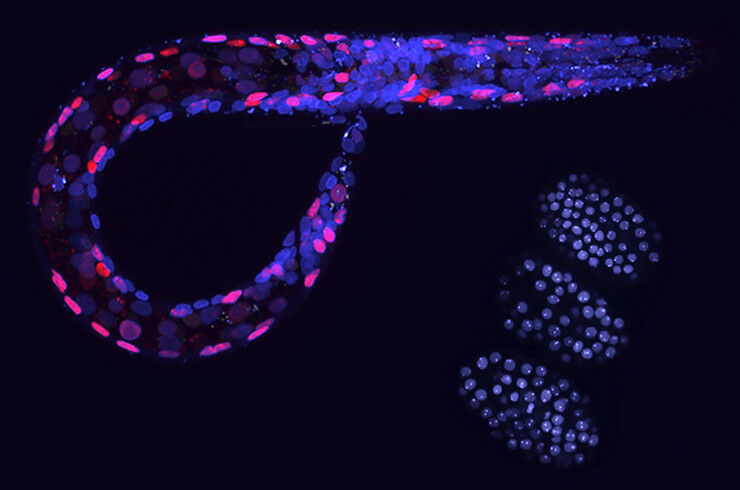
Composite image of a C. elegans larvae and three embryos, all lacking the H3K9-specific histone methyltransferase SET-25 (Source: FMI)
Composite image of a C. elegans larvae and three embryos, all lacking the H3K9-specific histone methyltransferase SET-25 (Source: FMI) - Transposons are foreign DNA elements capable of random insertion into the genome, an event that can be very dangerous for a cell. Their activity must be silenced to maintain genomic integrity, which is primarily achieved by H3K9me3-mediated repression. Researchers from the Gasser group identified two parallel pathways that are essential for H3K9me3- mediated transcriptional repression and thus for protecting the genome from toxic transposon activation. While our genome is the blueprint for every cell in our body, it is also a patchwork of our own DNA and foreign DNA elements that have been integrated over time. These non-self DNA elements are called transposons and are typically ancient integrations of viruses that once infected our cells. For an organism, it is vital to suppress the activity of these transposons, as they have the ability to induce their own amplification and reintegrate as novel copies into the genome, potentially disrupting the sequence of important genes. Consistently, transposon activation has been linked to sterility and cancer.
TO READ THIS ARTICLE, CREATE YOUR ACCOUNT
And extend your reading, free of charge and with no commitment.