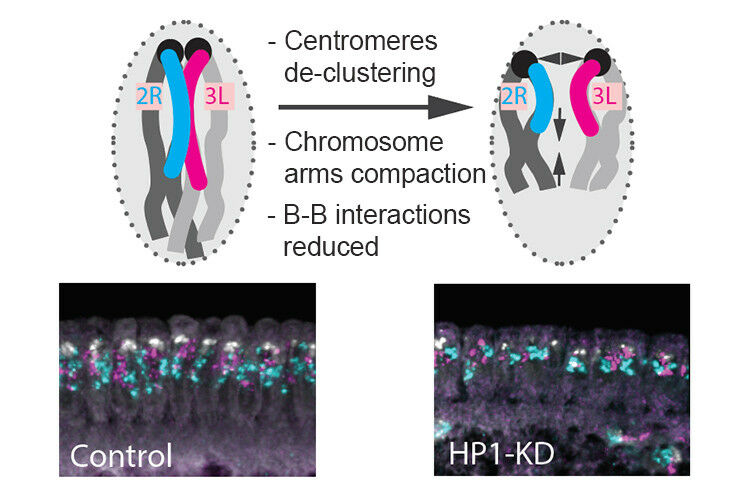
3D-DNA FISH stating of control (left) and HP1-knockdown (right) embryos
3D-DNA FISH stating of control ( left ) and HP1-knockdown ( right ) embryos - The spatial organization of the genome is fundamental for the regulation of our genes and has to be established de novo during early embryogenesis. By combining powerful Drosophila genetics with 3D chromosome modelling, a collaboration between the Giorgetti group at the FMI and the MPI of Immunobiology and Epigenetics in Freiburg revealed a critical role of the epigenetic regulator HP1 in the establishment of 3D genome organization in the early Drosophila embryo. The human genome is encoded by approximately 3 billion DNA base pairs and packaged into 23 pairs of chromosomes. If all chromosomes could be disentangled and linearly aligned, they would make up a thin thread of about 2 meters. The DNA molecule must therefore be extensively packaged to fit inside the tiny nucleus of each cell in our bodies. The chromatin fiber - made by DNA wounded around histone proteins - is fundamental for further packaging of the genetic material into chromosomes. The degree at which chromatin is packaged and folded in the nucleus also correlates with the timing and type of gene expression, but the molecular machinery that supervises the establishment of 3D chromatin organization remains largely unknown.
TO READ THIS ARTICLE, CREATE YOUR ACCOUNT
And extend your reading, free of charge and with no commitment.