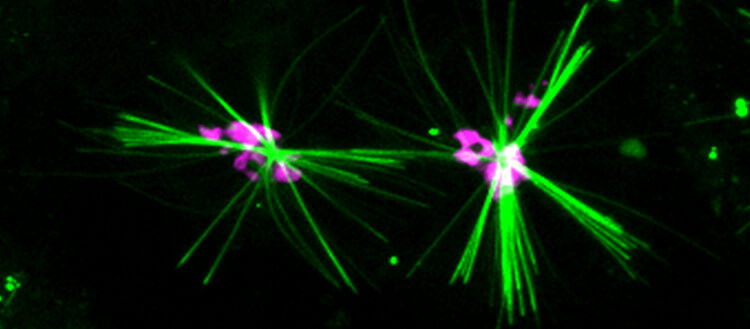
 A precipitating dye generates fluorescent, aster-like crystals (green) in live cells recording the motion of the motor protein kinesin-1 along microtubules. The crystals are centred in the Golgi apparatus (magenta) and extends towards the periphery of the cells, consistently with the transport activity of kinesin-1. © UNIGE
A precipitating dye generates fluorescent, aster-like crystals ( green ) in live cells recording the motion of the motor protein kinesin-1 along microtubules. The crystals are centred in the Golgi apparatus ( magenta ) and extends towards the periphery of the cells, consistently with the transport activity of kinesin-1. UNIGE - For the first time, a team from the University of Geneva has been able to follow precisely the path taken by a protein within the cell, paving the way for the study of the transport and distribution network of vital elements necessary for its survival. In order to stay alive, the cell must provide its various organelles with all the energy elements they need, which are formed in the Golgi apparatus, its centre of maturation and redistribution of lipids and proteins. But how do the proteins that carry these cargoes - the kinesins - find their way and direction within the cell's "road network" to deliver them at the right place? Chemists and biochemists at the University of Geneva , Switzerland, have discovered a fluorescent chemical dye, making it possible for the first time to track the transport activity of a specific motor protein within a cell. A discovery to be read . "It all started from a research that didn't go as planned," laughs Nicolas Winssinger, professor at the Department of Organic Chemistry of the Faculty of Science at UNIGE. "Initially, we wanted to develop a molecule that would make it possible to visualise the stress level of the cell, i.e. when it accumulates too much active oxygen species. During the experiment, the molecule did not work, but crystallised. Why did it crystallise?
TO READ THIS ARTICLE, CREATE YOUR ACCOUNT
And extend your reading, free of charge and with no commitment.
Your Benefits
- Access to all content
- Receive newsmails for news and jobs
- Post ads