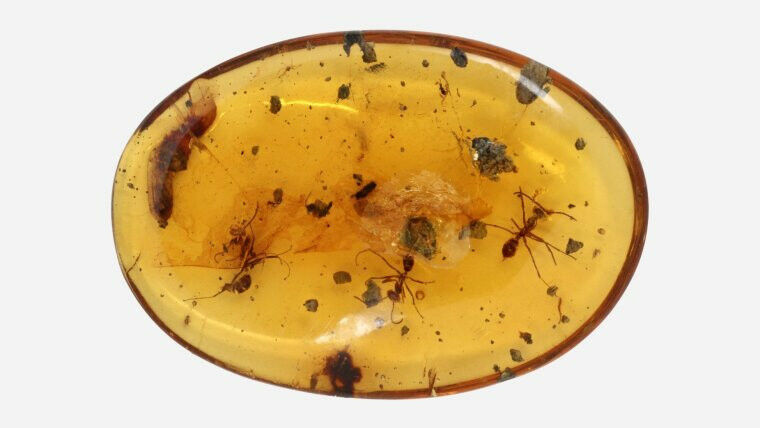
Fossils of female ants and a pupa enclosed in Cretaceous amber. Image: Shûhei Yamamoto
Fossils of female ants and a pupa enclosed in Cretaceous amber. Image: Shûhei Yamamoto - An international research team led by biologists from Friedrich Schiller University Jena has discovered material evidence that ants already lived in a special social system based on the division of labour more than 100 million years ago. Ants live in states organised according to the division of tasks. There are three castes, each of which has a different role: the queen lays eggs and the males fertilise them, while the workers look after the offspring and deal with finding food and nest-building. In biology, this special behaviour is called eusociality, which is developed in a particularly complex way in ants, as it is shown not only in their behaviour, but also in their morphology. Winged females take on the role of the queen, while wingless, infertile females perform the tasks of the workers. But when exactly in their evolution did ants start this unique teamwork? The research team has now established that this cooperative way of life developed in the early Cretaceous period and the scientists present their findings in the research journal "Zoological Journal of the Linnean Society".
TO READ THIS ARTICLE, CREATE YOUR ACCOUNT
And extend your reading, free of charge and with no commitment.