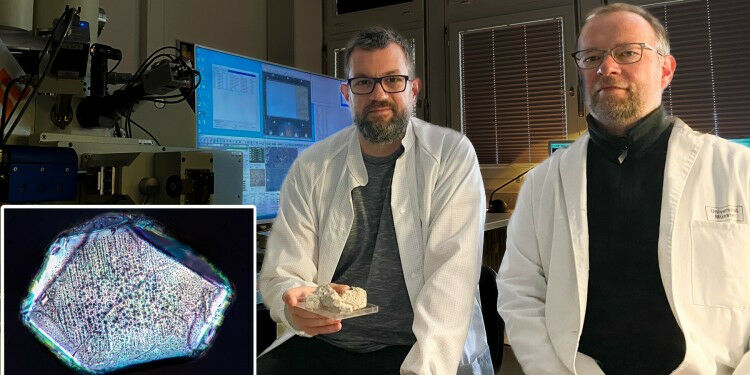
Geoscientists Jasper Berndt (left) and Stephan Klemme present a volcanic rock from Lake Laach. This Eifel rock contains the mineral Hauyn (about 0.5 mm), in which the researchers found the microscopic carbonatite melt inclusions (small picture below left). In the background is the ’Jeol electron beam microprobe’ with which the measurements were carried out. WWU - Institute of Mineralogy
Geoscientists Jasper Berndt ( left ) and Stephan Klemme present a volcanic rock from Lake Laach. This Eifel rock contains the mineral Hauyn (about 0.5 mm), in which the researchers found the microscopic carbonatite melt inclusions (small picture below left). In the background is the 'Jeol electron beam microprobe' with which the measurements were carried out. WWU - Institute of Mineralogy - Carbonatite rocks are economically important: The hundreds of known fossil carbonatite deposits on all continents are important storage sites for rare earth metals such as lanthanum, cerium, and neodymium. They are used in many key technologies, including smartphones, plasma and LCD screens, medical diagnostic radiology, wind turbine generators, and electric motors. Despite their economic importance, the formation of carbonatites is insufficiently understood. Scientists at the Westfälische Wilhelms-Universität (WWU) Münster have now demonstrated for the first time that these rocks are formed by segregation from silicate magmas.
TO READ THIS ARTICLE, CREATE YOUR ACCOUNT
And extend your reading, free of charge and with no commitment.