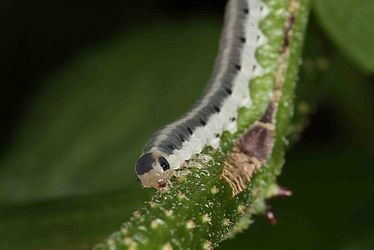
The larvae of the sawfly Macrophya alboannulata , like about 50 other insects, feed on the leaves of various elderberry species, especially black elderberry. Photo: Martin Gossner
The larvae of the sawfly Macrophya alboannulata , like about 50 other insects, feed on the leaves of various elderberry species, especially black elderberry. Photo: Martin Gossner - Flowers are sexual structures of plants that are normally assumed to have evolved in harmony with their mutualistic pollinators such as bees, butterflies and honeybirds. However, a new study involving the Swiss Federal Institute for Forest, Snow and Landscape Research WSL shows that herbivorous insects play a central role. In a recent article published in the journal Ecology Letters, researchers show that flower sexuality is controlled by herbivores such as leaf-, stemand root-eating grasshoppers, beetles and caterpillars. The research team demonstrated that plant species that are attacked by more insect herbivores have flowers that are more masculine, an indicator of their higher effort to produce a genetically-diverse offspring. Instead of a casual finding, this result was indeed predicted by the Red Queen Hypothesis, a theory created to explain the very existence of sex. The Red Queen Hypothesis was proposed to explain an important mystery that challenges the Darwinian theory.
TO READ THIS ARTICLE, CREATE YOUR ACCOUNT
And extend your reading, free of charge and with no commitment.