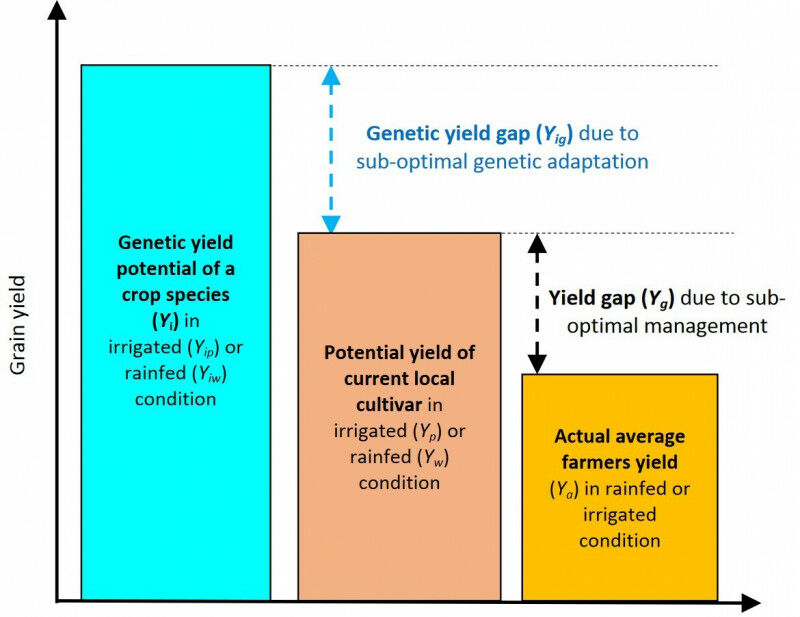
Veranschaulichung der ’genetischen Ertragslücke’ (Yig) gegenüber der ’klassischen Ertragslücke’ (Yg) für Weizen - modifiziert nach van Ittersum et al. 2013, Field Crops Research. Die Balken in der Abbildung sind nicht maßstabsgetreu. Photo: Nimai Senapati et al 2022
Veranschaulichung der 'genetischen Ertragslücke' (Yig) gegenüber der 'klassischen Ertragslücke' (Yg) für Weizen - modifiziert nach van Ittersum et al. Field Crops Research. Die Balken in der Abbildung sind nicht maßstabsgetreu. Photo: Nimai Senapati et al 2022 International research team investigates genetic yield gaps in wheat Exploiting the genetic yield gap in wheat could significantly improve global food security. This is one of the key findings of an international study on yield gaps in wheat, in which the University of Göttingen was involved. The study, which uses a novel process-based modeling approach, also suggests that global wheat production could be doubled if wheat genotypes were better adapted to their target environment. The findings were published in Nature Food .
TO READ THIS ARTICLE, CREATE YOUR ACCOUNT
And extend your reading, free of charge and with no commitment.