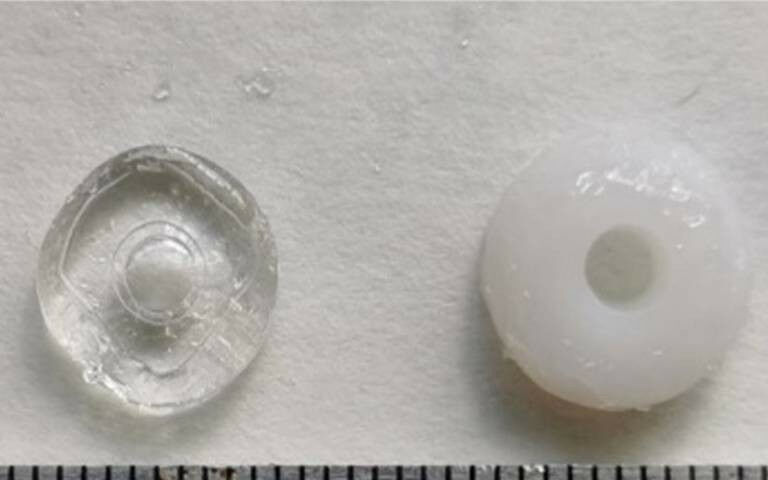
3D printed paracetamol printlets - 3D-printed paracetamol printlets
3D printed paracetamol printlets - 3D-printed paracetamol printlets - Medicines can be printed in seven seconds in a new 3D-printing technique that could enable rapid on-site production of medicines, reports a UCL-led research team. The findings published in the journal, Additive Manufacturing , improve the prospects of how 3D printers could be integrated into fast-paced clinical settings for on-demand production of personalised medicines. For the current study, the researchers loaded printlets (printed tables) with paracetamol, which is one of many medicines that can be produced with a 3D printer. One of the leading techniques for 3D printing is vat photopolymerisation, which affords the highest resolution for complexity at microscales, and also suits many medications as it does not require high heat. For printing medicines, the technique uses a resin formulation, constituting the required drug dissolved in a solution of a photoreactive chemical, activated by light to solidify the resin into a printed tablet. But vat polymerisation has been hampered by slow printing speeds, due to its layer-by-layer approach. Here, scientists have developed a new vat polymerisation technique that prints the entire object all at once, reducing the printing speed from multiple minutes to just seven to 17 seconds (depending on the resin composition selected).
TO READ THIS ARTICLE, CREATE YOUR ACCOUNT
And extend your reading, free of charge and with no commitment.