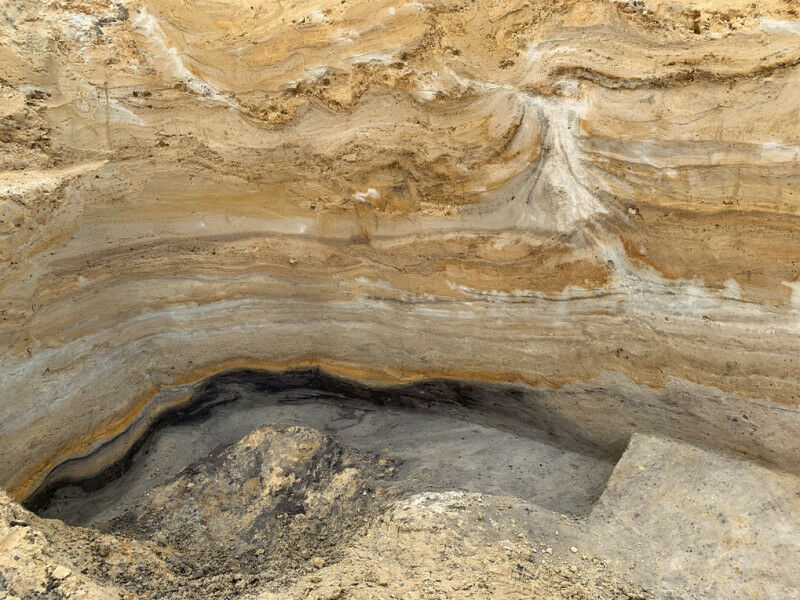
 Lake shore (black organic layer) from 90,000 years ago superimposed by cold climatic sediments.
Lake shore (black organic layer) from 90,000 years ago superimposed by cold climatic sediments. M. Weiss / M. Hein - A multidisciplinary research team from the Max Planck Institute for Evolutionary Anthropology in Leipzig, the Friedrich Alexander University Erlangen-Nuremberg, the Leuphana University Lüneburg, the Leibniz Institute for Applied Geophysics and other partner institutions investigated whether Neanderthals were well adapted to life in the cold or preferred more temperate environmental conditions. Based on investigations in Lichtenberg in the Wendland region (Lower Saxony, Germany), the researchers showed that during the last Ice Age, Neanderthals visited their northernmost settlement areas even during cold phases - albeit preferably in the summer months. Were Neanderthals really as well adapted to a life in the cold as previously assumed, or did they prefer more temperate environmental conditions during the last Ice Age? To answer these questions, it is worthwhile to examine Neanderthal sites on the northern periphery of their range. After all, it was there that environmental fluctuations were most noticeable, especially as a result of repeated ice advances from Scandinavia. A region particularly suitable for such investigations is northern Germany, with its numerous documented Neanderthal sites. In a recent study, researchers from the Max Planck Institute for Evolutionary Anthropology , the University Erlangen-Nuremberg , the Leuphana University Lüneburg, the Leibniz Institute for Applied Geophysics and other partner institutions have now investigated the remains of Neanderthals at a former lakeshore in Lichtenberg in the Wendland region (Lower Saxony).
TO READ THIS ARTICLE, CREATE YOUR ACCOUNT
And extend your reading, free of charge and with no commitment.
Your Benefits
- Access to all content
- Receive newsmails for news and jobs
- Post ads