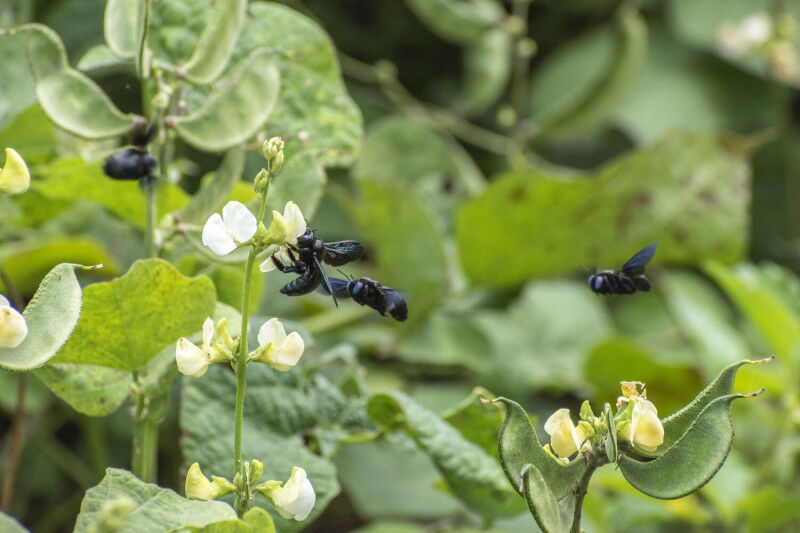
Large solitary cavity-nesting bees such as Carpenter bees (Xylocap spp.) can benefit from urbanization provided they find enough flower resources Photo: Vikas S Rao
Large solitary cavity-nesting bees such as Carpenter bees (Xylocap spp.) can benefit from urbanization provided they find enough flower resources Photo: Vikas S Rao Research team led by Göttingen University compares biodiversity across rural and urban landscapes Urbanization is a primary threat to biodiversity. However, scientists know little about how urbanization affects biodiversity and ecosystem services in tropical regions of the Global South. An international research team led by the Universities of Göttingen and Hohenheim in Germany, in collaboration with the University of Agricultural Sciences of Bangalore in India, investigated the effects of urbanization on bee communities in smallholder farms in and around Bangalore - a South Indian city with more than 13 million inhabitants. They found that social bees, such as wild honey bees, suffered more than large solitary bees or those that nest in cavities, which contrasts with results from temperate regions. Native flowering plants adjacent to farmland and crop diversification can help to maintain social bee colonies. The findings were published in the journal Ecological Applications.
TO READ THIS ARTICLE, CREATE YOUR ACCOUNT
And extend your reading, free of charge and with no commitment.