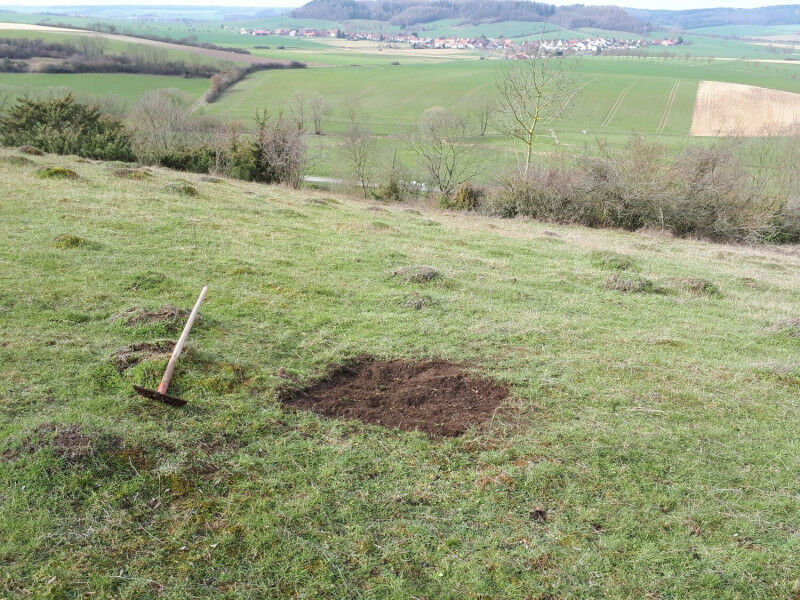
Creation of vegetation-free patches (1m²) on a calcareous grassland near Göttingen. Photo: Hanna Gardein
Creation of vegetation-free patches (1m²) on a calcareous grassland near Göttingen. Photo: Hanna Gardein Göttingen researchers investigate ways to improve conservation management of wild bees on calcareous grasslands Relatively little is known about the nesting requirements of ground-nesting wild bees, although nesting sites are of central importance for most wild bee species. There are almost 600 wild bee species in Germany and 75 per cent nest in the soil. To date, however, most of the research has concentrated on the wild bee species that nest above ground in cavities. Now, researchers at the University of Göttingen have shown in a study on calcareous grasslands that the removal of vegetation in small areas led to a significant increase in ground nests, especially if there was a high abundance of flowering plants nearby. The results were published in Global Ecology and Conservation . Experimental setup: vegetation-free patch (1m², left) with adjacent control plot ( right ).
TO READ THIS ARTICLE, CREATE YOUR ACCOUNT
And extend your reading, free of charge and with no commitment.