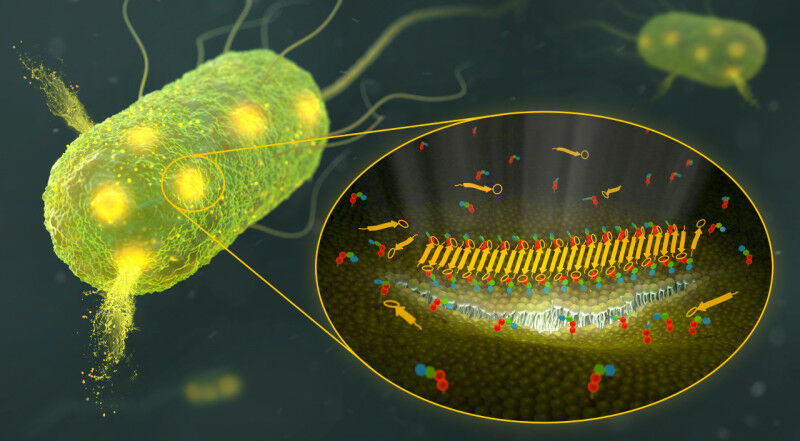
Long fibrils of teixobactin (yellow arrows) and lipid II (red-blue dots) lead to weak spots in the cell membrane of the bacterium. Image: Barth van Rossum.
Long fibrils of teixobactin (yellow arrows) and lipid II (red-blue dots) lead to weak spots in the cell membrane of the bacterium. Image: Barth van Rossum. Scientists at Utrecht University have discovered a new mechanism of how antibiotics kill bacteria. The antibiotic teixobactin uses a dual molecular strategy: it blocks the bacterial cell wall synthesis and destructs the cell membrane, the researchers write in the scientific journal Nature . The new insights could enable the design of powerful antibiotics against which bacteria do not readily develop resistance. Antibiotics are used to treat bacterial infections and are among the most widely used drugs worldwide. They are vital to combat many infections in the respiratory and intestinal tracts, as well as various skin conditions.
TO READ THIS ARTICLE, CREATE YOUR ACCOUNT
And extend your reading, free of charge and with no commitment.