3D cell structure of snow alga S. nivaloides.
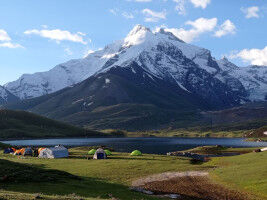
3D cell structure of snow alga S. nivaloides. Grégory Si Larbi (LPCV) In the spring, Alpine glaciers sometimes don a sheer red or orangish veil. Known as 'red snow' or 'blood snow', this phenomenon is caused by the blooming of Sanguina nivaloides , a microscopic alga. Scientists from the CNRS, the French Alternative Energies and Atomic Energy Commission (CEA), Météo-France, INRAE, and Université Grenoble Alpes 1 turned their attention to this organism, which forms the pillar of a snowy ecosystem still poorly understood. Through their investigation 2 , whose findings have just been published in Nature Communications , they determined that S. nivaloides does not live in ice crystals but rather grows in the water circulating within the snow, around those crystals. The biologists then studied the cellular architecture of the algae using 3D electron microscopy, discovering adaptations that permit its life in the snow. For example, they noted that the cellular membrane of S. nivaloides is covered with small wrinkles that increase its external surface area.
TO READ THIS ARTICLE, CREATE YOUR ACCOUNT
And extend your reading, free of charge and with no commitment.
Your Benefits
- Access to all content
- Receive newsmails for news and jobs
- Post ads