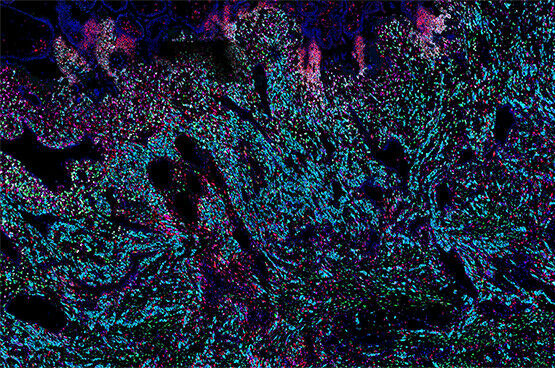
Researchers have revealed what happens in the early stages of placental development, a process crucial for a successful pregnancy. Credits: Kenny Roberts, Wellcome Sanger Institute.
Researchers have revealed what happens in the early stages of placental development, a process crucial for a successful pregnancy. Credits: Kenny Roberts, Wellcome Sanger Institute. For the first time, researchers have mapped the full trajectory of placental development. Their work could offer new insights into pregnancy disorders and help develop better experimental models of the human placenta. Researchers from the FMI led by Margherita Yayoi Turco, the Wellcome Sanger Institute, the University of Cambridge and EMBL's European Bioinformatics Institute have created an in-depth picture of how the placenta develops and communicates with the uterus. The team used single-cell genomics and spatial transcriptomics technologies to analyze a rare historical set of samples, capturing the process of placental development in unprecedented detail. These techniques allowed the researchers to see all the cell types involved in the early stages of placenta formation and uncover how some placenta cells communicate with the uterine environment around them.
TO READ THIS ARTICLE, CREATE YOUR ACCOUNT
And extend your reading, free of charge and with no commitment.