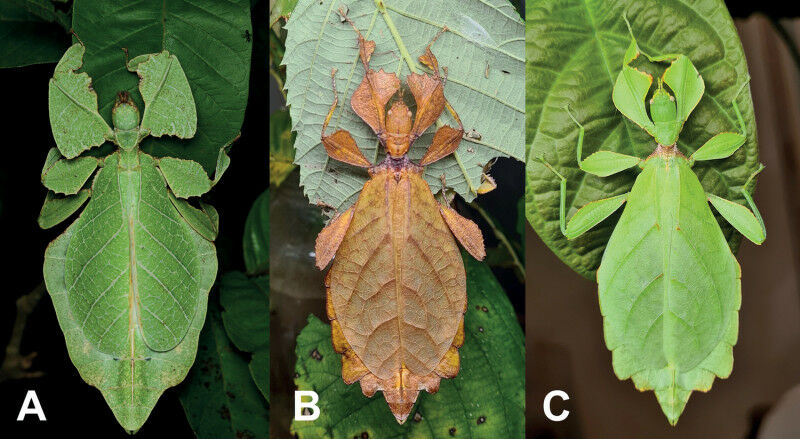
Appearances can be deceptive: the appearance of leaf insects does not necessarily reflect their species affiliation. While Pulchriphyllium anangu (A) is a new, distinct species from India, the other two individuals (B and C) both belong to the newly described Philippine species Phyllium ortizi, despite their external differences. Photo: Vishwanath Gowda (A), Maxime Ortiz (B und C)
Appearances can be deceptive: the appearance of leaf insects does not necessarily reflect their species affiliation. While Pulchriphyllium anangu (A) is a new, distinct species from India, the other two individuals (B and C) both belong to the newly described Philippine species Phyllium ortizi, despite their external differences. Photo: Vishwanath Gowda (A), Maxime Ortiz (B und C) Research team including Göttingen University describes seven new species of walking leaves An international research team including the University of Göttingen has described seven previously unknown species of leaf insects, also known as walking leaves. The insects belong to the stick and leaf insect order, which are known for their unusual appearance: they look confusingly similar to parts of plants such as twigs, bark or - in the case of leaf insects - leaves. This sophisticated camouflage provides excellent protection from predators as well as presenting a challenge to researchers. Genetic analysis enabled the researchers to discover -cryptic species-, which cannot be distinguished by their external appearance alone. The findings are not only important for the systematic study of leaf insects, but also for the protection of their diversity.
TO READ THIS ARTICLE, CREATE YOUR ACCOUNT
And extend your reading, free of charge and with no commitment.