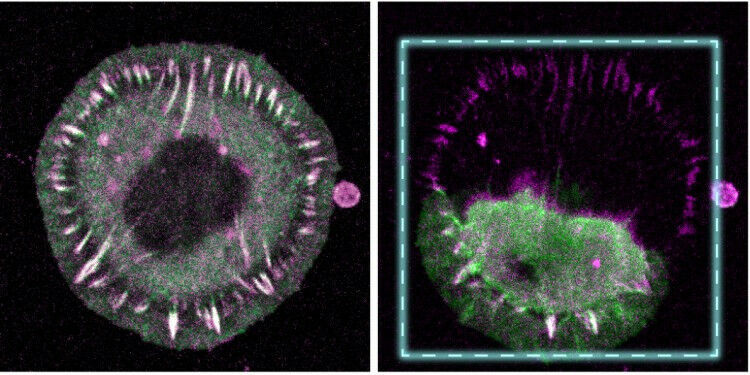
 The figure shows a connective tissue cell in which the adhesion protein talin has been modified. As long as no laser light with a suitable wavelength is switched on, the cell forms normal adhesion structures, which are important for attachment to the surrounding tissue (left). Irradiation with short laser pulses leads to a rupture of the talin connection, the importance of which immediately becomes clear: without intact talin connections, the cell can no longer hold on to the underlying substrate and collapses (right).
Team led by biologist Carsten Grashoff from the University of Münster has developed a new method for examining mechanical processes in cells / Study published in Science Advances. The figure shows a connective tissue cell in which the adhesion protein talin has been modified. As long as no laser light with a suitable wavelength is switched on, the cell forms normal adhesion structures, which are important for attachment to the surrounding tissue ( left ). Irradiation with short laser pulses leads to a rupture of the talin connection, the importance of which immediately becomes clear: without intact talin connections, the cell can no longer hold on to the underlying substrate and collapses ( right ). AG Grashoff The cells in our body are continuously exposed to mechanical forces that are either externally applied or generated by the cells themselves. Being able to respond to such mechanical stimuli is an indispensable prerequisite for a large number of biological processes. However, how cells manage to process mechanical stimuli is poorly understood because techniques to study the very fine mechanical signals in cells are lacking.
TO READ THIS ARTICLE, CREATE YOUR ACCOUNT
And extend your reading, free of charge and with no commitment.
Your Benefits
- Access to all content
- Receive newsmails for news and jobs
- Post ads