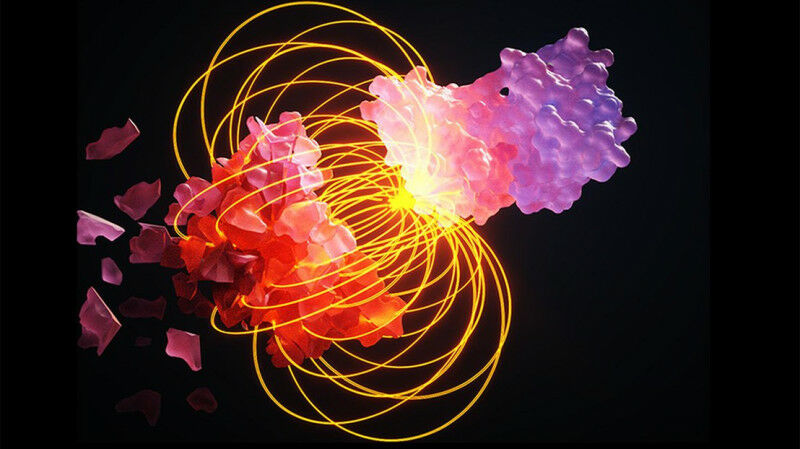
 Protein surfaces vary widely and are dynamic, making it hard to predict how and where binding events will occur.
Protein surfaces vary widely and are dynamic, making it hard to predict how and where binding events will occur. Ella Maru Studio By using deep learning-generated 'fingerprints' to characterize millions of protein fragments, researchers have computationally designed novel protein binders that attach seamlessly to key targets, including the SARS-CoV-2 spike protein. In 2019, scientists in the joint School of Engineering and School of Life Sciences Laboratory of Protein Design and Immunoengineering ( LPDI ) led by Bruno Correia developed MaSIF: a machine learning-driven method for scanning millions of protein surfaces within minutes to analyze their structure and functional properties. The researchers' ultimate goal was to computationally design protein interactions by finding optimal matches between molecules based on their surface chemical and geometric 'fingerprints'. Four years later, they have achieved just that. In a paper published in Nature, they report that they have created brand-new proteins called binders that are designed to interact with four therapeutically relevant protein targets, including the SARS-CoV-2 spike protein. Engineering a perfect molecular match Physical interactions between proteins influence anything from cell signaling and growth to immune responses, so the ability to control protein-protein interactions is of great interest to the fields of biology and biotechnology.
TO READ THIS ARTICLE, CREATE YOUR ACCOUNT
And extend your reading, free of charge and with no commitment.
Your Benefits
- Access to all content
- Receive newsmails for news and jobs
- Post ads