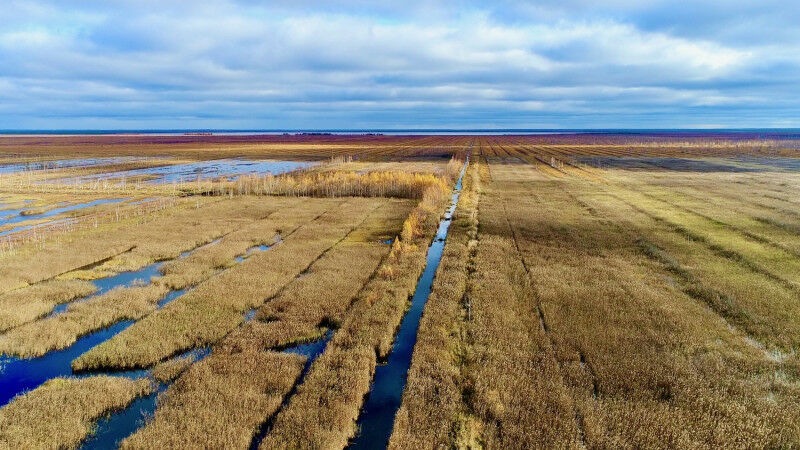
The Orshinski Mokh wetland in Tver province, Russia. A quarter of the wetland was drained between 1950 and 1990 for the extraction of peat, which was used as fuel to supply energy to a neighbouring settlement. Photo: Kirill Shakhmatov
The Orshinski Mokh wetland in Tver province, Russia. A quarter of the wetland was drained between 1950 and 1990 for the extraction of peat, which was used as fuel to supply energy to a neighbouring settlement. Photo: Kirill Shakhmatov International research team including Göttingen University investigates extent of drainage and conversion The drainage of natural wetlands has been useful for farming, forestry and peat extraction, but has also had a major impact on greenhouse gas emissions, flood control, nutrient loss and biodiversity. In a global study, an international research team led by Stanford University has reconstructed where and when wetlands were converted between the years 1700 and 2020, and why this was done. The University of Göttingen was involved in the study, for instance, regarding information on agricultural projects to convert wetlands as well as about drainage in irrigated agriculture. The results were published in the journal Nature. The map shows both the differences in the geographical distribution of wetlands, which were influenced by the actions of people, compared to wetlands, which were not influenced by the actions of people, and the estimated cumulative percentage of wetland loss between1700 and 2020.
TO READ THIS ARTICLE, CREATE YOUR ACCOUNT
And extend your reading, free of charge and with no commitment.