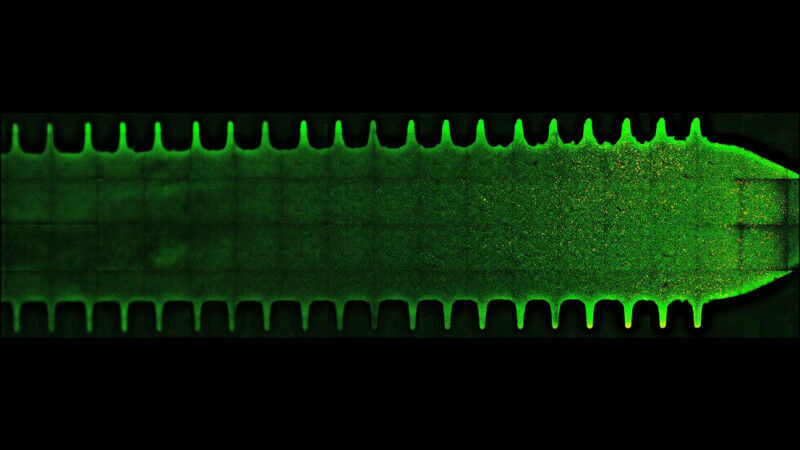
The gut commensals Bacteroides thetaiotaomicron and B. fragilis form biofilms in crypt-like features. Credit: Jeremy Wong (EPFL)
The gut commensals Bacteroides thetaiotaomicron and B. fragilis form biofilms in crypt-like features. Credit: Jeremy Wong (EPFL) A groundbreaking study reveals that the flow of fluids influences the spatial organization of bacterial communities that inhabit our intestines, revealing an overlooked factor potentially mediating our microbiome and gut health. Our gut is home to a diverse community of bacteria known as the gut microbiota. These bacteria play a crucial role in our health by supporting digestion, producing essential nutrients, maintaining a balanced immune system and even affecting our mood and behavior. Understanding the factors that shape gut microbiota composition is crucial, as disruptions in this delicate balance have been associated with various health conditions, including inflammatory bowel disease, obesity, and metabolic disorders. In a new study, scientists led by Alex Persat at EPFL's School of Life Sciences now provides new insights into how the physical forces of flowing fluids in our gut shape bacterial communities. Working with the lab of Tom Battin at EPFL's School of Architecture, Civil and Environmental Engineering, and colleagues at ETH Zurich, the work provides insights into the intricate mechanisms by which different bacterial species of the microbiota interact with one another by sharing nutrients.
TO READ THIS ARTICLE, CREATE YOUR ACCOUNT
And extend your reading, free of charge and with no commitment.