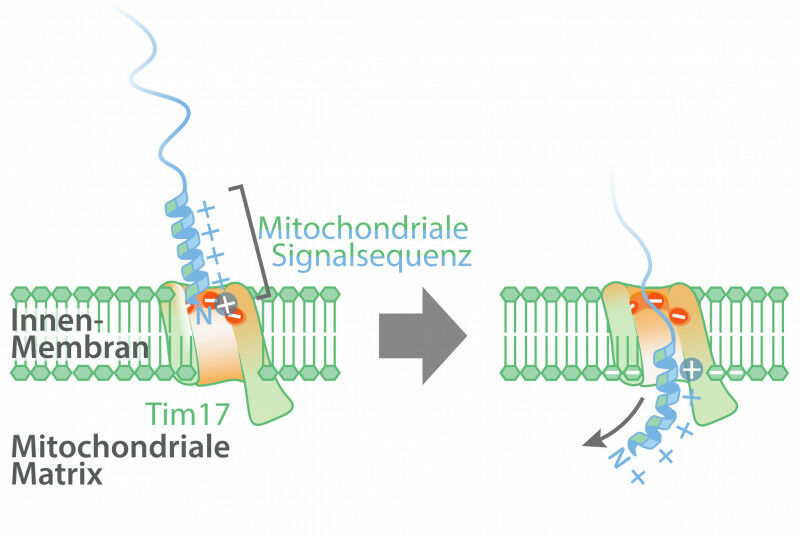
Model of the import of mitochondrial proteins with a signal sequence across the mitochondrial inner membrane at the Tim17 groove. Illustration: Laura Fielden
Model of the import of mitochondrial proteins with a signal sequence across the mitochondrial inner membrane at the Tim17 groove. Illustration: Laura Fielden - Scientists reveal the transport of positively charged signal sequences through negatively charged groove Known as the power plant of the cell, mitochondria are essential to human metabolism. Human mitochondria consist of 1,300 different proteins and two fatty biomembranes. The vast majority of mitochondrial proteins are produced with a cleavable transport signal and have to be actively transported into the mitochondria. Using biochemical and cell-biology experiments, a team of researchers have now shown for the first time precisely how mitochondrial proteins with signal sequences are imported into the mitochondria via a negatively charged, unique groove. Headed by Nils Wiedemann and Prof. Dr. Carola Hunte from the Medical Faculty at the University of Freiburg, and Martin van der Laan from the University of Saarland the work was carried out at the University of Freiburg's Cluster of Excellence CIBSS - Centre for Integrative Biological Signalling Studies. Their results have been published in the science journal Nature.
TO READ THIS ARTICLE, CREATE YOUR ACCOUNT
And extend your reading, free of charge and with no commitment.