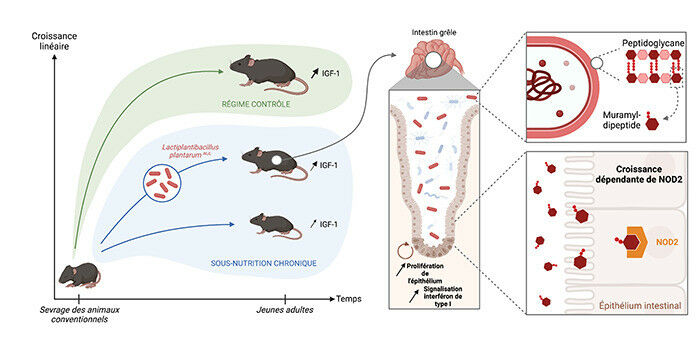
 The LpWJL bacterial strain enhances growth of undernourished mice via signalling triggered by intestinal NOD2 receptor recognition of muramyl dipeptide from the bacterial cell wall.
The LpWJL bacterial strain enhances growth of undernourished mice via signalling triggered by intestinal NOD2 receptor recognition of muramyl dipeptide from the bacterial cell wall. © Amélie Joly 1 While insulin-like growth factor 1 (IGF-1), mainly produced by the liver, has a chemical structure similar to that of insulin, these hormones have distinct functions: IGF-1 stimulates tissue and skeletal growth, whereas insulin regulates energy metabolism as required for growth. The gut microbiota is now thought to constitute an organ in its own right. The work of a team led by scientists from the CNRS and ENS de Lyon, in collaboration with Claude Bernard Lyon 1 University, INSERM, and INRAE, is the subject of an upcoming article in Science . These researchers have learned how a certain microbiotic bacterial strain stimulates the growth of undernourished young animals. Though essential for health, microbiotic activity is still poorly understood. Through earlier studies, an international research team, 1 directed by scientists from the Institute of Functional Genomics of Lyon (CNRS / ENS de Lyon), demonstrated that the gut microbiota plays a key role in the growth of juvenile individuals belonging to species as different as drosophilas and house mice.
TO READ THIS ARTICLE, CREATE YOUR ACCOUNT
And extend your reading, free of charge and with no commitment.
Your Benefits
- Access to all content
- Receive newsmails for news and jobs
- Post ads


