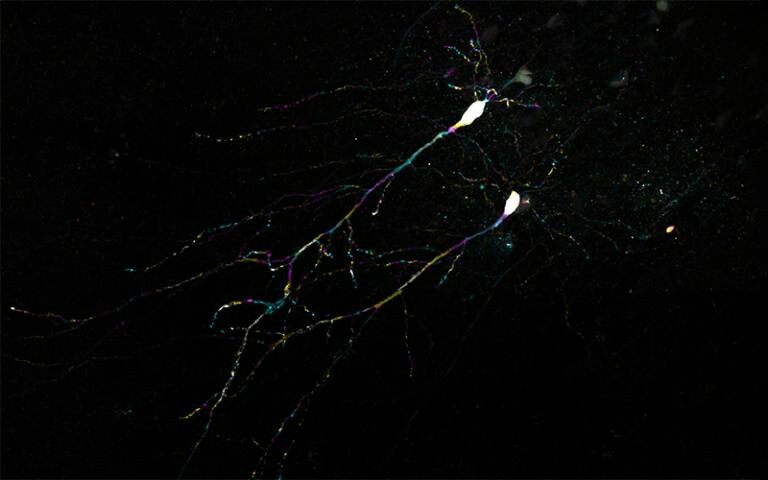
Mouse hippocampus neurons - Hippocampus neurons in the mouse brain, projecting towards the nucleus accumbens in the forebrain. Credit: Dr Ryan Wee, UCL
Mouse hippocampus neurons - Hippocampus neurons in the mouse brain, projecting towards the nucleus accumbens in the forebrain. Credit: Dr Ryan Wee, UCL A hunger hormone produced in the gut can directly impact a decision-making part of the brain in order to drive an animal's behaviour, finds a new study by UCL researchers. The study in mice, published in Neuron , is the first to show how hunger hormones can directly impact activity of the brain's hippocampus when an animal is considering food. Lead author Dr Andrew MacAskill (UCL Neuroscience, Physiology & Pharmacology) said: "We all know our decisions can be deeply influenced by our hunger, as food has a different meaning depending on whether we are hungry or full. Just think of how much you might buy when grocery shopping on an empty stomach. But what may seem like a simple concept is actually very complicated in reality; it requires the ability to use what's called 'contextual learning'. "We found that a part of the brain that is crucial for decision-making is surprisingly sensitive to the levels of hunger hormones produced in our gut, which we believe is helping our brains to contextualise our eating choices." For the study, the researchers put mice in an arena that had some food, and looked at how the mice acted when they were hungry or full, while imaging their brains in real time to investigate neural activity.
TO READ THIS ARTICLE, CREATE YOUR ACCOUNT
And extend your reading, free of charge and with no commitment.