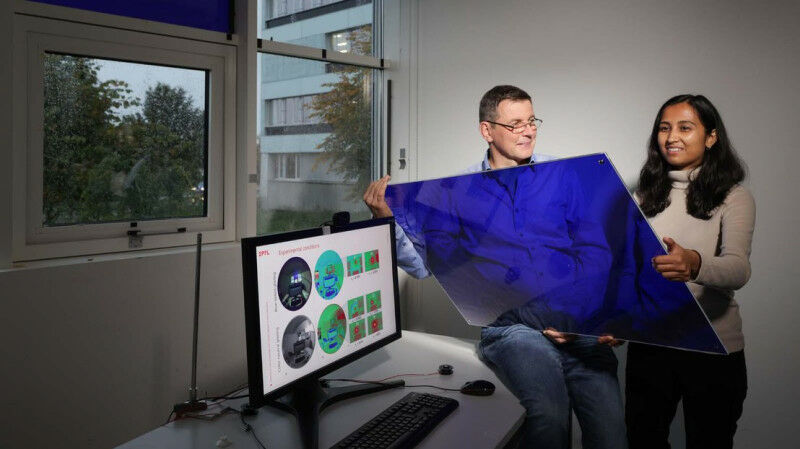
 Sneha Jain and Jan Wienold hold one of the filters for their daylight experiment
Sneha Jain and Jan Wienold hold one of the filters for their daylight experiment © 2023 EPFL / Alain Herzog. Understanding glare is important for improving visual comfort in the built environment. Specific pigments in the eye reduce perception of glare from a blue colored light source, but the pigments do not explain sensitivity to neutrally colored light, scientists show. What is glare? Simply put, glare is visual discomfort often leading to annoyance, fatigue or even headaches. Perception of glare varies from person to person, and one set of lighting conditions may be comfortable for one person yet uncomfortable for another. But why? Is there a physiological explanation behind this, especially relating to certain individual differences in the eye? The aim is to assess glare risks indoors to promote comfortable, sustainable and healthy environments. Sneha Jain © 2023 EPFL / Alain Herzog.
TO READ THIS ARTICLE, CREATE YOUR ACCOUNT
And extend your reading, free of charge and with no commitment.
Your Benefits
- Access to all content
- Receive newsmails for news and jobs
- Post ads