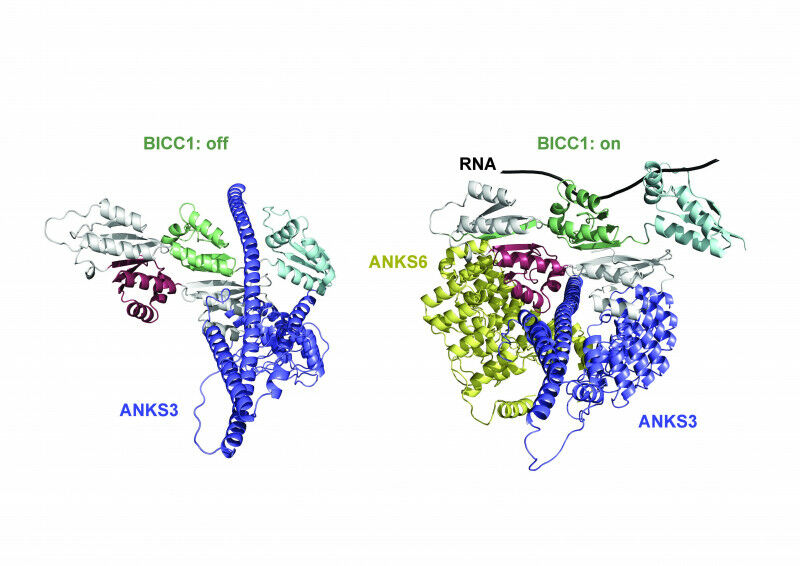
The three proteins BICC1, ANKS3 and ANKS6 interact to bind and regulate mRNAs in asymmetric organ development. Credit: Benjamin Rothé and Zhidian Zhang (EPFL).
The three proteins BICC1, ANKS3 and ANKS6 interact to bind and regulate mRNAs in asymmetric organ development. Credit: Benjamin Rothé and Zhidian Zhang (EPFL). EPFL researchers uncover a complex protein network that controls asymmetric organ development in the embryo, providing new insights into genetic diseases and basic biology. To monitor their environment, cells use cilia - antenna-like structures capable of detecting various stimuli, including fluid flow outside the cell. Genetic defects that cause cilia to malfunction and lose their sensory capabilities can lead to diseases known as "ciliopathies", notably polycystic kidney disease. They can also disrupt the correct asymmetrical positioning of internal organs during embryonic development, known as "organ laterality". The heart, which is normally located on the left side, is an example of this asymmetry.
TO READ THIS ARTICLE, CREATE YOUR ACCOUNT
And extend your reading, free of charge and with no commitment.