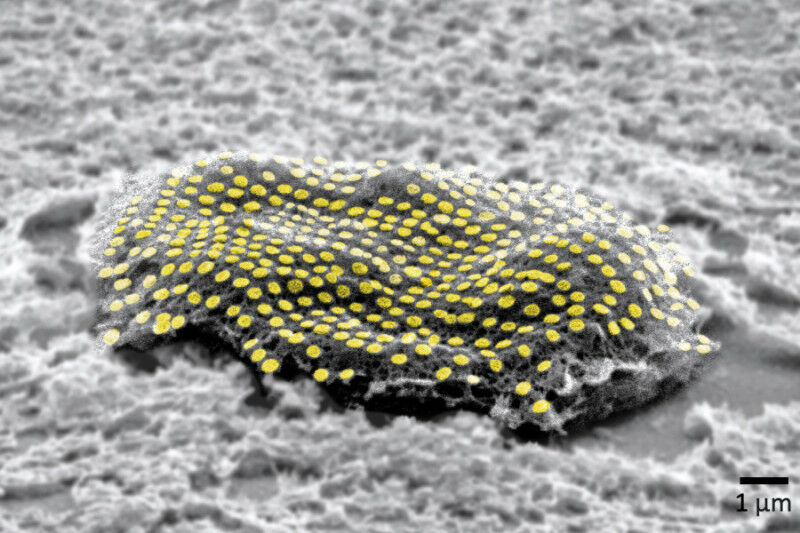
Black and white microscope image of a fibroblast cell with an array of gold nanodots highlighted in yellow.
New technology involving dots and wires adhering to live cells could some day provide early warnings for health problems. Black and white microscope image of a fibroblast cell with an array of gold nanodots highlighted in yellow. Engineers have developed nanoscale tattoos-dots and wires that adhere to live cells-in a breakthrough that puts researchers one step closer to tracking the health of individual cells. The new technology allows for the first time the placement of optical elements or electronics on live cells with tattoo-like arrays that stick on cells while flexing and conforming to the cells' wet and fluid outer structure. "If you imagine where this is all going in the future, we would like to have sensors to remotely monitor and control the state of individual cells and the environment surrounding those cells in real time," said David Gracias , a professor of chemical and biomolecular engineering at Johns Hopkins University who led the development of the technology. "If we had technologies to track the health of isolated cells, we could maybe diagnose and treat diseases much earlier and not wait until the entire organ is damaged." - "If we had technologies to track the health of isolated cells, we could maybe diagnose and treat diseases much earlier and not wait until the entire organ is damaged." - David Gracias The details are published in Nano Letters . Gracias, who works on developing biosensor technologies that are nontoxic and noninvasive for the body, said the tattoos bridge the gap between living cells or tissue and conventional sensors and electronic materials.
TO READ THIS ARTICLE, CREATE YOUR ACCOUNT
And extend your reading, free of charge and with no commitment.