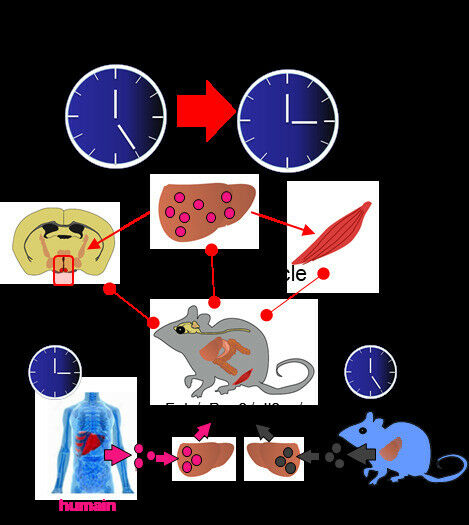
The "humanized" mouse model receives liver cells from normal mice (control animals) or human liver cells (humanized mice). The presence of human liver cells leads to a modification of the circadian clock of the liver, the muscle and affects the central clock (the suprachiasmatic nucleus, SCN) which results in a phase advance "shift of the circadian rhythms" in the humanized animal which sees its metabolism and its behaviors advanced by a few hours. Luquet et al / Science Advances
The "humanized" mouse model receives liver cells from normal mice (control animals) or human liver cells (humanized mice). The presence of human liver cells leads to a modification of the circadian clock of the liver, the muscle and affects the central clock (the suprachiasmatic nucleus, SCN) which results in a phase advance "shift of the circadian rhythms" in the humanized animal which sees its metabolism and its behaviors advanced by a few hours. Luquet et al / Science Advances The liver may influence the body's central biological clock, a group of brain cells that influence most physiological and behavioral aspects. Our liver partly controls our central biological clock, according to scientists from CNRS and Université Paris Cité. Their study, to be published on May 17, 2023 in the journal Science Advances, has indeed shown that it was possible to shift the biological clock of mice by introducing human liver cells into their liver. The biological or circadian clock allows organisms to regulate their activity according to the daily cycle. It relies on the action of a central clock, represented by a group of brain cells, the suprachiasmatic nucleus, which synchronizes the circadian clocks of all organs, called peripheral clocks.
TO READ THIS ARTICLE, CREATE YOUR ACCOUNT
And extend your reading, free of charge and with no commitment.