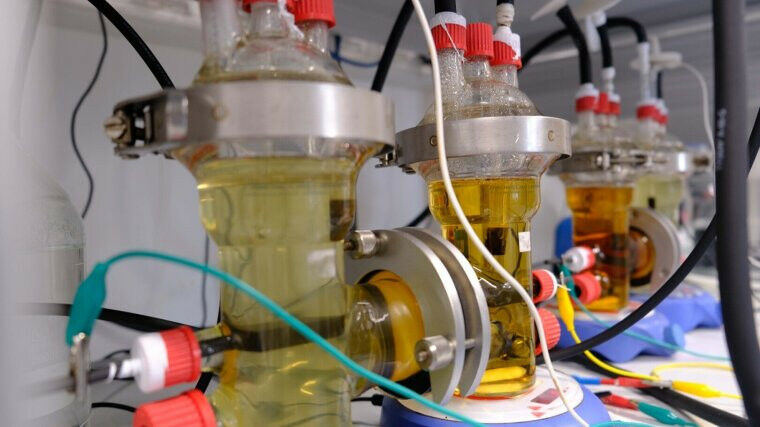
In Mini-Bioreaktoren kontrollieren die Forschenden die Bedingungen der mikrobiellen Elektrosynthese. Foto: Ronja Münch/Leibniz-HKI
In Mini-Bioreaktoren kontrollieren die Forschenden die Bedingungen der mikrobiellen Elektrosynthese. Foto: Ronja Münch/Leibniz-HKI - In microbial electrosynthesis, microorganisms use CO2 and electricity to produce alcohol, for example. How this process works biologically, however, was previously only speculated. Researchers in Jena have now been able to confirm experimentally for the first time that bacteria use electrons from hydrogen and can produce more chemicals than previously known. Microbial electrosynthesis is a promising technology against the backdrop of climate change and the energy transition: It can bind carbon dioxide, produce ethanol and other organic compounds that can be used as fuel, and thus store surplus electricity. Nevertheless, the technology, which has been known for more than a decade, has not yet been able to achieve any significant breakthrough. According to Miriam Rosenbaum, this is mainly because "the biology behind the process has so far been regarded as a kind of black box ".
TO READ THIS ARTICLE, CREATE YOUR ACCOUNT
And extend your reading, free of charge and with no commitment.