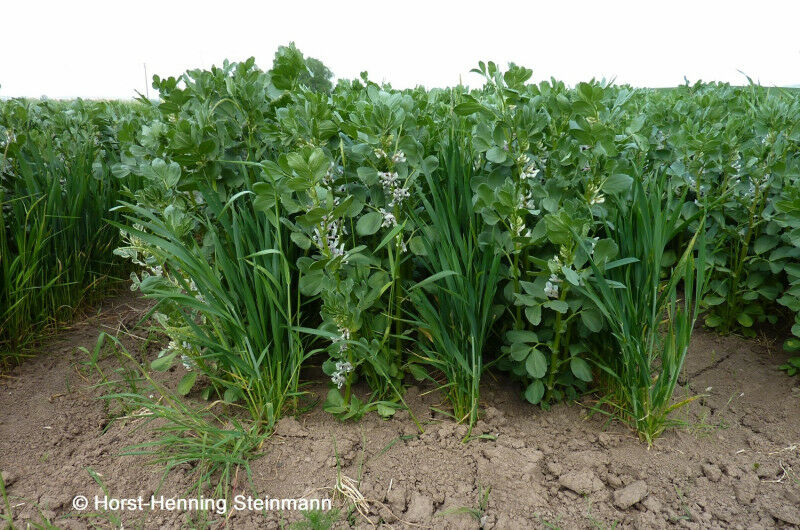
A mixture of crops: faba bean and wheat Photo: Horst-Henning Steinmann
A mixture of crops: faba bean and wheat Photo: Horst-Henning Steinmann Researchers at Göttingen University investigate attractiveness of wheat-bean crop mixtures for pollinating insects There are often too few flowering plants in agricultural landscapes, which is one reason for the decline of pollinating insects. Researchers at the University of Göttingen have now investigated how a mixture of crops of faba beans (broad beans) and wheat affects the number of pollinating insects. They found that areas of mixed crops compared with areas of single crops are visited equally often by foraging bees. Their results were published in the journal Agriculture, Ecosystems & Environment. A bee feeding from the glower of a faba bean Photo: Nicole Beyer - The researchers observed and counted foraging honeybees and wild bees in mixtures of wheat and faba bean and in pure cultures that only contained faba beans. "We had expected that the mixed crops with fewer flowers would be visited less frequently by bees for foraging than single crops," says PhD candidate Felix Kirsch from the Functional Agrobiodiversity research group, University of Göttingen. "To our surprise, this was not the case." Felix Kirsch Photo: Arne Wenzel This could be due to several reasons.
TO READ THIS ARTICLE, CREATE YOUR ACCOUNT
And extend your reading, free of charge and with no commitment.