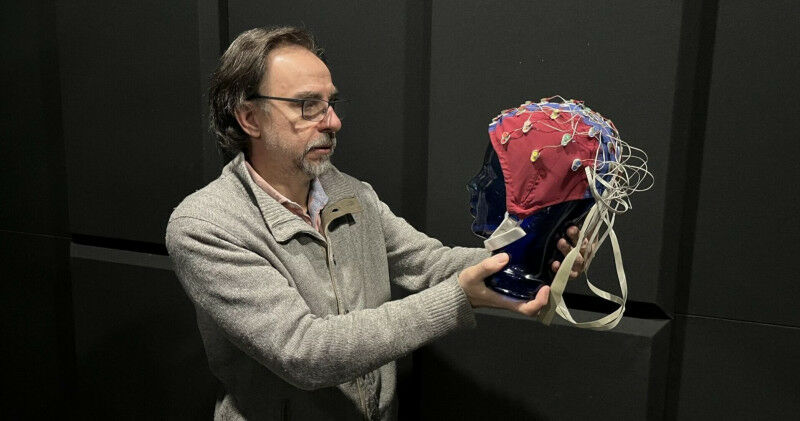
Physics professor Andrea Soddu holds a simulation head with an EEG cap. (Jeff Renaud)
Researchers discover new way to understand and diagnose patients experiencing ringing in the ears. Physics professor Andrea Soddu holds a simulation head with an EEG cap. (Jeff Renaud) - While it's especially common in older adults, tinnitus - a potentially devastating ringing in the ears - can affect people of all ages. Most often described as consistent buzzing, hissing or humming, tinnitus is usually caused by an underlying condition, like age-related hearing loss, an ear injury or heart disease and affects approximately one in five people in North America. Because the noise an affected individual hears isn't caused by an external sound and there are no discernible biomarkers, it's extremely difficult for clinicians to assess, diagnose and treat tinnitus. A new study led by Andrea Soddu may provide a clearer picture of the levels of distress tinnitus sufferers are experiencing. The Western medical physicist and an international team of collaborators have developed a new classification procedure for tinnitus patients using data acquired by electroencephalography (EEG), a technique that measures electrical activity in the brain using small electrodes placed on the scalp.
TO READ THIS ARTICLE, CREATE YOUR ACCOUNT
And extend your reading, free of charge and with no commitment.