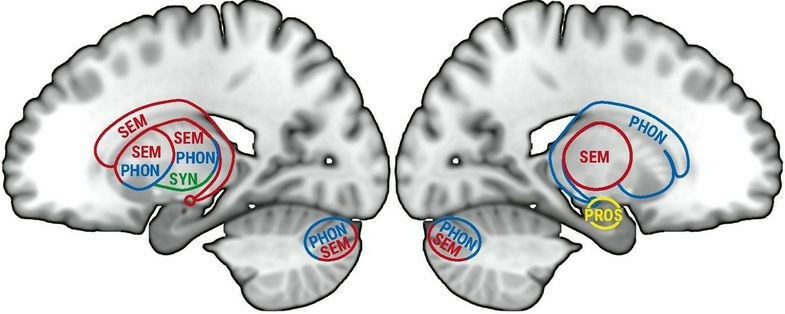
Schematic representation of the contribution of subcortical and cerebellar regions to the processing of language meaning (SEM), grammar (SYN) and phonetic properties of letters, syllables and words (PHON) and sentences...
Schematic representation of the contribution of subcortical and cerebellar regions to the processing of language meaning (SEM), grammar (SYN) and phonetic properties of letters, syllables and words (PHON) and sentences. A new study has provided the first clear picture of where language processes are located in the brain. The findings may be useful in clinical trials involving language recovery after brain injury. Dr Sabrina Turker, Dr Philipp Kuhnke and Professor Gesa Hartwigsen from the Wilhelm Wundt Institute of Psychology at Leipzig University and the Max Planck Institute for Human Cognitive and Brain Sciences conducted the meta-analysis in collaboration with researchers from Forschungszentrum Jülich. They have published their findings in the prestigious journal Psychological Bulletin. Language is the most important tool for human communication and essential for life in our society. "Despite a great deal of neuroscientific research on the representation of language, little is known about the organisation of language in the human brain.
TO READ THIS ARTICLE, CREATE YOUR ACCOUNT
And extend your reading, free of charge and with no commitment.