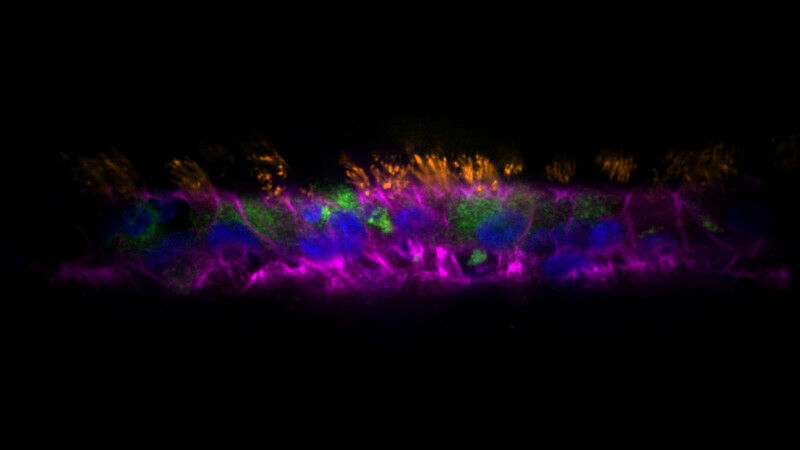
Human airway epithelial cells after growth and differentiation inside an AirGel tissue-engineered airway. Green: mucus; orange: cilia; pink: actin; blue: nuclei. Credit: Tamara Rossy (EPFL)
Human airway epithelial cells after growth and differentiation inside an AirGel tissue-engineered airway. Green: mucus; orange: cilia; pink: actin; blue: nuclei. Credit: Tamara Rossy (EPFL) In a breakthrough for bioengineering, researchers at EPFL have developed organoids that can model the human respiratory tract. The organoids, called AirGels, allow them to uncover the mechanism by which antibiotic-resistant pathogens like Pseudomonas aeruginosa infect the respiratory tract. Biofilms are highly resistant communities of bacteria that pose a major challenge in the treatment of infections. While studying biofilm formation in laboratory conditions has been extensively conducted, understanding their development in the complex environment of the human respiratory tract has remained elusive. A team of researchers led by Alexandre Persat at EPFL have now cracked the problem by successfully developing organoids called AirGels.
TO READ THIS ARTICLE, CREATE YOUR ACCOUNT
And extend your reading, free of charge and with no commitment.