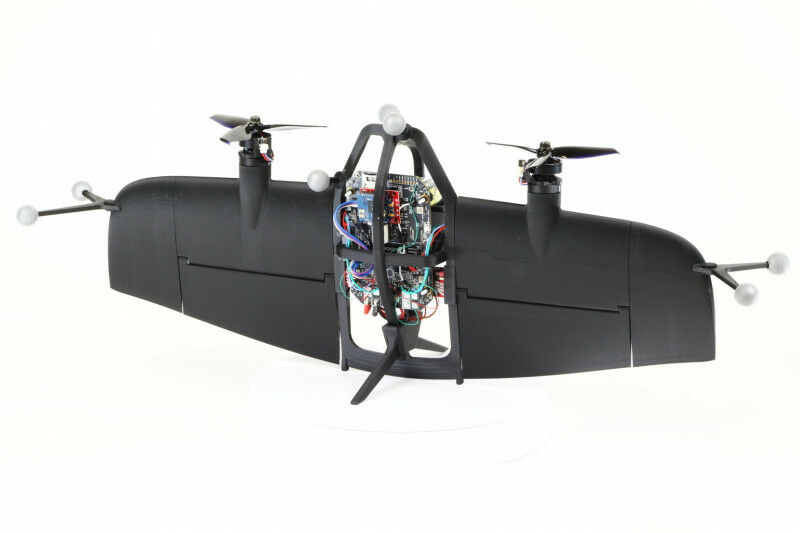
MIT researchers developed new algorithms for trajectory planning and control of fixed-wing ’tailsitter’ aircraft, which are faster and more efficient than traditional quadcopter drones. Credits : Image: Courtesy of the researchers
MIT researchers developed new algorithms for trajectory planning and control of fixed-wing 'tailsitter' aircraft, which are faster and more efficient than traditional quadcopter drones. Credits : Image: Courtesy of the researchers With this new approach, a tailsitter aircraft, ideal for search-and-rescue missions, can plan and execute complex, high-speed acrobatic maneuvers. A tailsitter is a fixed-wing aircraft that takes off and lands vertically (it sits on its tail on the landing pad), and then tilts horizontally for forward flight. Faster and more efficient than quadcopter drones, these versatile aircraft can fly over a large area like an airplane but also hover like a helicopter, making them well-suited for tasks like search-and-rescue or parcel delivery. MIT researchers have developed new algorithms for trajectory planning and control of a tailsitter that take advantage of the maneuverability and versatility of this type of aircraft. Their algorithms can execute challenging maneuvers, like sideways or upside-down flight, and are so computationally efficient that they can plan complex trajectories in real-time. Typically, other methods either simplify the system dynamics in their trajectory planning algorithm or use two different models, one for helicopter mode and one for airplane mode.
TO READ THIS ARTICLE, CREATE YOUR ACCOUNT
And extend your reading, free of charge and with no commitment.