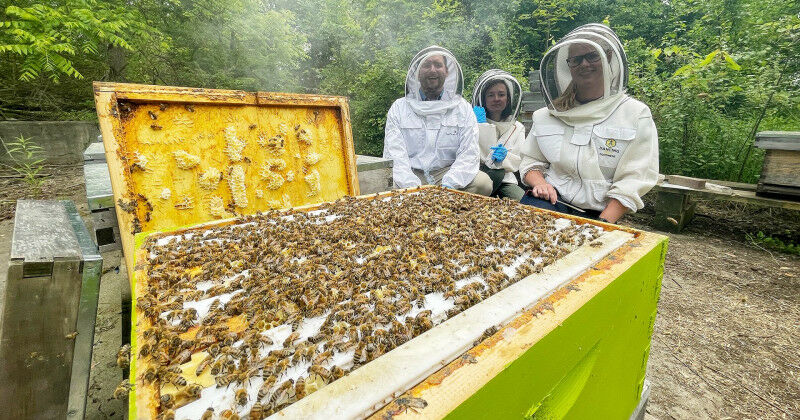
Western researchers Brendan Daisley, Anna Chernyshova and Sophie Killam at the experimental apiaries on campus. (Western Communications)
Western researchers Brendan Daisley, Anna Chernyshova and Sophie Killam at the experimental apiaries on campus. (Western Communications) Research team studies how changing honeybee gut microbiota contributes to hive health and influences social behaviour Widespread pesticide-use and diminished floral diversity in the environment have contributed to the worsening susceptibility of honeybees to infectious disease, threatening their support of adequate pollination of food crops. With the aim of tackling honeybee decline, researchers at Western University have shown certain probiotic bacteria can be used to help ward off disease and promote overall hive health. A new study published today in the journal ISME , used two methods to deliver probiotics to hives within large commercial apiaries in California - a probiotic pollen patty and a spray-based delivery system - demonstrating a range of health benefits associated with the supplementation. "We tend to think of bees just as organisms in themselves. But actually, bees have co-evolved with a lot of other organisms, the plants they feed on, and the bacteria that live inside their guts," said Graham Thompson, biology professor at Western who has been studying honeybees for over two decades. "Those bacteria are functionally very important to the bees, for digestion and acquiring nutrients.
TO READ THIS ARTICLE, CREATE YOUR ACCOUNT
And extend your reading, free of charge and with no commitment.